Happily Single & Childfree

Join the Community!


The American Spinster


  • What Makes A Modern Spinster?

    What Makes A Modern Spinster?

    The word “spinster” has had a number of different meanings over its long history. Lately, with the rise of solo living and the childfree alternative, it seems to be being redefined once again. What does it mean to be a modern spinster?

    What Does “Spinster” Mean?

    Traditionally, a spinster is a never-married woman without biological children. The word itself originated as a professional title. Spinster: a person who spins fibers into yarn or thread. As spinning was one of the few respectable professions available to unmarried women, it eventually became synonymous with “unmarried woman.”

    Of course, respectable unmarried women of the past couldn’t have sex openly, and were therefore typically childless. However both literary and real-life spinsters were known to sometimes adopt.

    Does the Modern Spinster Exist?

    Though something of an archaic term now, “spinster” still carries some negative connotations. Rather than “spinster” describing an independent woman who earns her own living and contributes to the economy directly, the word was used to refer to a woman who had ‘failed.’ That is, failed to do the two things her society told her to do: marry and have children.

    And while we certainly still see the remnants of this belief system in our modern world, we’ve also made great strides toward incorporating spinsterhood into the culture in a positive way. More and more books about the solo and childfree lifestyles are being published each decade, and even those who are morally opposed to these lifestyles are at least beginning to listen.

    What Is A Modern Spinster?

    Spinsterhood and Feminism

    We can’t talk about modern spinsterhood without also talking about feminism. Feminism is, of course, a belief in the innate equity between men and women. This means that women should not be held to a different set of rules, standards, and social statuses than men simply because of their gender or biological sex.

    So basically, the 19th century’s definition of a spinster is completely antithetical to the feminist viewpoint. Why’s that?

    1. There is no corresponding term with similar connotations to the term “spinster” that exists for men.
    2. Neither is there a corresponding social status for men. A bachelor doesn’t exist in separate social striation from married men. Yet spinsters are a class all their own.
    3. Until the late 19th century in England, women had to remain spinsters in order to own property. Men could own property regardless of marital status. (In America, though laws vary from state to state, married women1 achieved land-owning rights a few decades before spinsters2.)ย 

    To sum up: What men were able to contribute to society was often independent of their marital status. What women were able to contribute to society was entirely dependent on their marital status.

    30 Days to LOVE Being Single | FREE Email Course

    So What Makes a Modern Spinster?

    Okay, we know what an old-timey spinster was, and we know that that doesn’t square with our contemporary ideals of equality. So what is a modern spinster?

    The modern spinster, if she is any type of feminist at all, believes that her worth as an individual is not tied to whether or not she has acquired a long-term mate. Her status as “unmarried” (or “unmarried and childfree”) is unrelated to her role in society. And while she may (or may not) wish to marry at some point in her life, she doesn’t see her solo status as a fault or lack.

    What Is A Modern Spinster

    None of us are going to be perfectly happy with every part of our lives at all times. (I mean, if you’re fully enlightened maybe. But the rest of us will not.) There are going to be days when we solo women feel lonely; when we childfree wonder if we really are missing out. But ideally the modern spinster doesn’t live her life under the shadow of social restraints resulting from her marital status. She is herself, first and foremost; her relationship to others is secondary. She is, overall, happily single and childfree.

    Single or Solo? What Makes a Modern Spinster?


    Do you see yourself as a modern spinster? What has your experience as a happily single and childfree woman been like? Let me know in the comments below.

    All images are provided by Kaboompics.


    Leave a Reply

    Your email address will not be published. Required fields are marked *

    This site uses Akismet to reduce spam. Learn how your comment data is processed.


  • Top 5 Books on the Childfree Lifestyle

    Top 5 Books on the Childfree Lifestyle

    One of the greatest challenges childfree women and couples face is the feeling of isolation. While it’s true that the internet has helped us connect to other like-minded individuals, that support network could use some bolstering. If you’re looking for information or validation regarding the childfree lifestyle, you’re in luck. I’ve compiled a short list of the top five best books on the topic of being childfree.

    Below are five books that will:

    • show you how older, childfree people feel
    • validate your feelings and beliefs about children/childfree life
    • assure you that you’re not selfish
    • expose common parental regrets
    • did deep into the ideology and idolization of motherhood

    Ready? The let’s dive in.

    5. Kid Me Not: An anthology of childfree women of the 60s now in their 60s.

    The self-righteous warning of, “You’ll regret it when you’re older” falls flat next to this collection of childfree women who are still happily childfree. If you’re not sure about having children, this respectful anthology, edited by Aralyn Hughes, will give you a peak at the seldom looked-at lives of older women without children.

    4. The Mommy Myth: The Idealization of Motherhood and How It Has Undermined All Women

    The “Mommy Myth” is just as false, oversold, and harmful as the “Angel in the House” was to Victorian women. Yet modern Westerners are still eagerly seduced by it. Douglas and Michaels deconstruct this set of beliefs and present it plainly for what it is: a harmful, unrealistic ideal that harms mothers as much as the childfree.

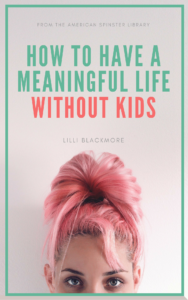
    Get the FREE ebook, "How to Have a Meaningful Life without Kids"

    3. Selfish, Shallow, and Self-Absorbed: Sixteen Writers on the Decision Not to Have Kids.

    As the tongue-in-cheek title suggests, this collection of essays from various writers is a deeply personal, very self-aware exploration of the decision to remain childfree. If you’re looking for an intimate one-on-one meeting with a childfree mentor, this book is for you.

    (Above is an excerpt from the book read by Blair of the Respectfully Childfree YouTube channel.)

    2. Confessions of a Childfree Woman

    60 Minutes dealt a severe blow to the childfree by choice movement, as well as Marcia Drut-Davis’ personal life after her edited interview aired. Despite being reviled for the audacious decision to not have children (she even received death threats after the broadcast), Drut-Davis refused to be bullied. This is the story of her life and how it has been shaped both by her decision and by her appearance in that fateful interview.

    If you’d like to learn more first, check out my my review here.

    1. The Baby Matrix

    Laura Carroll’s The Baby Matrix presents the idea that women are designed to be mothers as nothing more than human-constructed ideology. Just as Neo learns to see the matrix for what it really is, so the reader learns to see how the ideological wool has been pulled over our eyes for so long.

    You can also read my full review of The Baby Matrix here.

    Have you read any of these books already? Are there any other books on the childfree lifestyle you wish I’d included on this list? Let me know in the comments below!

    Top 5 Books on the Childfree Lifestyle | The American Spinster

    If you’d like to receive more helpful resources for your single & childfree life, join the American Spinster mailing list:


    Leave a Reply

    Your email address will not be published. Required fields are marked *

    This site uses Akismet to reduce spam. Learn how your comment data is processed.


  • Is It Selfish to Have Kids?

    Is It Selfish to Have Kids?

    One of the most common remarks on the childfree lifestyle is that it’s selfish. How is it selfish to not have a child one doesn’t want or can’t afford? Search me. Though we’ve tackled that question in the past, today I’m asking: Is it selfish to have kids?

    Is It Selfish to Have Kids? | The American Spinster

    It’s certainly true that some parents have children for incredibly selfish reasons. While I don’t have any large-scale statistics, I can say that when I ask a parent why they had children, nearly every single one replies with one of two answers:

    • “I just wanted to have kids.”
    • “I wanted to be a mom.”

    But does that mean that it’s necessarily selfish to have kids?

    When Having Kids is Definitely Selfish

    First let me say that I know that people find themselves pregnant in less-than-ideal circumstances, and that the decision to have an unplanned child is deeply personal. Additionally, the decision to continue a pregnancy one didn’t anticipate isn’t quite the same as choosing to become pregnant in the first place.

    Having said that, willfully deciding to have a baby when there is currently no baby or developing baby in the picture, and when one cannot provide (emotionally, financially, or physically) is going to be a selfish decision in most cases.

    What are the factors the unselfish person considers when planning to conceive?

    Is It Selfish to Have Kids? | The American Spinster

    Financial Resources

    There are a lot of strong feelings on this topic, and for good reason. Like it or not, we live in an economically unfair society, and it’s deeply unjust for anyone to say, “poor people need to not have babies they can’t afford” when one’s entire childbearing years might be spent in the low-income brackets. It may well take we Millennials a couple of decades (into our forties) to make it to the point when we can financially afford children. And why should we have to put off having children to the time where it’s no longer a biologically viable option?

    That line of thinking gets uncomfortably close to the eugenics-based belief of breeding economically disadvantaged people or groups out of the gene pool. And no one, least of all me, wants that. But here’s the thing: recklessly having babies does absolutely nothing to fix this unfair system. And, not to beat a dead horse, but having children will not improve your finances.

    At the end of the day, despite how very nuanced this topic is, having children you can’t afford is selfish. It’s putting your desires before the well-being of another.

    Emotional Availability

    This one doesn’t seem to discriminate based on one’s bank account or social class. If you have a child as the ‘default’ option in your life, rather than something you’ve weighed seriously and put conscious thought into, you’re not making the effort needed to be emotionally available to your child.

    Kids take a lot of emotional strength, stability, and endurance. Enforcing boundaries and maintaining consistency requires a committed and compassionate mindset. If you have a child without doing anything to prepare yourself for that kind of emotional marathon, that’s selfish too. It’s saying that your emotional needs (feeling loved and needed by a baby) are more important that your child’s emotional needs.

    Time Availability

    Good parenting requires time and self-discipline in time management. Do you have the time to devote to implementing a routine? Do you have time to actually interact with and get to know your kids? Children learn, grow, and change at a much more rapid rate than most adults. This requires taking time to understand who your child is and what their point of view is. If you don’t have that, you won’t have a clue why they’re acting the way they do. And that just leads to frustration, anger, and disappointment.

    Once again, if you know you won’t have the ability (or are not willing to make the sacrifices needed) to give your child the time they need, it’s selfish to have one anyway. Again, it’s putting your desires before the needs of another.

    Is It Selfish to Have Kids? | The American Spinster

    When Having Kids Might Be Selfish

    Okay. So what if you can afford to give a child a decent life, see yourself as being emotionally available to them, and have actually put the effort into learning about being a good parent? What if you’re the type of would-be parent who has carefully considered the details of how you’ll raise your child and made a plan ahead of time with your partner? Is it selfish to have children then?

    The short answer is, well, maybe.

    The longer answer is that while you may not be putting your own wants above the needs of your future child, you may still be putting your own wants above the needs of others. And those are people who already exist, not a person who hasn’t yet been created.

    There are two main factors to consider.

    Overpopulation

    There’s simply no denying the fact that we live on an overpopulated planet. Is it selfish to create a new person when millions are starving, and hundreds of millions 1  2 of children are unwanted? Well, that leads directly into the next factor…

    Biological Arrogance and Exclusivity

    And finally, there’s the issue of biological conceit. This conceit says, “my genes (or my partner’s genes) are so much more valuable to me than any others on the planet that I’m going to create a new person at the expense of all the parentless children throughout the globe.” It’s closely related to the belief that one’s genes are genuinely better than those of children with “issues” in foster care. And let me state this plainly: if you believe that adopting a child with “problems” is more than you’re up for, you probably aren’t up for the challenge of raising a bio kid either (see above).

    Is your desire to see your partner’s features in your child really more important the the needs of an existing child? If so, it’s possible that you’re acting out of selfishness.

    Is It Selfish to Have Kids? | The American Spinster

    So Is It Ever NOT Selfish to Have Kids?

    I don’t want to end this article with the idea that becoming a parent is innately selfish, because I truly don’t believe it is. And I don’t think that most people who have children for selfish reason do so consciously. In my experience talking to parents, the main reason that people have children for selfish reasons (and are often disappointed as a result) is that they never paused to think critically about having children before they did it.

    The point of this post isn’t to bash parents or say that parents are horrible, selfish creatures. It’s to encourage everyone reading to give the decision to have children the serious consideration it deserves. If you were considering spending the next 20 years of your life in a convent, devoted entirely to serving God, and paying some $230,000 to do so, wouldn’t you give it a few weeks of serious thought first? Why, then, don’t we give the decision to have kids that same level of self-reflection?

    What Does the Unselfish Parent Look Like?

    Before I close, I do want to include a very thoughtful answer to the “why do you want kids” question given to me by a friend.

    My family has dwindled. I want to add more members to my family; more people to share things with in my circle. I’d also like the opportunity to “pass the baton” to someone. Like, I want to see the world become a better place, and I feel like I’d be leaving “unfinished business” if I just died and didn’t have someone that I passed the “make-the-world-a-better-place-ness” on to. Keep in mind I do not require this/these added family member/s to be grown in my body, though I’m not against that.

    So is it selfish to have kids? No, not necessarily. Can it be? Yes, definitely. As is the case with most acts, it’s one’s intentions, forethought, and preparation that determine whether something is greedy or giving in nature. So decide what’s best for you, but please, consider these things before making that life-changing, and (in the case of bio babies) life-creating decision.


    Get the FREE ebook, "How to Have a Meaningful Life without Kids"


    Leave a Reply

    Your email address will not be published. Required fields are marked *

    This site uses Akismet to reduce spam. Learn how your comment data is processed.


  • When Parenthood Means Passing The Buck

    When Parenthood Means Passing The Buck

    People have kids for many different reasons. Some of them are good reasons. But sometimes, having children is simply an excuse to forward the bill to the next generation.

    We glorify the noble father who sets asides his dreams to work hard and raise his kids. We idolize the woman who first proves her worth by going to college and landing a high-paying job, then chooses to give it up to have kids. And if having kids is one’s true dream, sure. That’s fine. But giving up on your actual dreams to have kids instead is just passing the buck.

    Here’s what I mean.

    Why Live for Yourself When You Can Live Vicariously?

    So often I see new mothers mapping out their children’s lives with the sole intention of giving their child the life they want. And I always want to say, “Why don’t you just give yourself that life? Why create a new human in an overpopulated world when you can love the you who already exists?” Putting your wishes and dreams onto someone else doesn’t help anyone, especially not the kids who never signed up for that. You might as well say, “Forgo your dreams and live mine because I opted not to live them myself. You can just pass your own dreams on to your children anyway.”

    But then there’s the other way of passing the buck to future generations…

    "Smart women, you could be a smart scientist or you could make six smart scientists. Which serves society better?"
    “Smart women, you could be a smart scientist or you could make six smart scientists. Which serves society better?”

    Where to begin? For right now, let’s set aside the idea that children are people rather than modeling clay. I want to instead look at the notion presented in this text that essentially says a “smart” woman can contribute more to society by creating more people than she can by fulfilling a socially vital role.

    And okay, I can see where you could maybe make that argument if you believe that molding children with precision is possible (and healthy). But there are still a couple of glaring and inexcusable problems. These are:

    • The world has more than enough potential scientists.
    • Women are capable of contributing as they are.

    Let’s look at that further, shall we?

    When Parenthood Means Passing The Buck | The American Spinster

    The Pro-Natal Mindset

    The United States is a very pro-natal nation. That is, we are all about producing some babies. Clearly, before the agricultural and (especially) industrial revolutions, humans needed to reproduce often and successfully to sustain the species. But despite the fact that we’ve kind of got that covered, some nations fear that localized under-population will result in their demise. Even on a planet bursting with 7.6 billion people (there were only 1 billion in 1800), a slight decline in birth rates has some people worried.

    The Reality of Pro-Natalism in the Modern World

    Basically, we’re stuck in the evolutionary mindset that says, “Making babies is your most important job!” despite the fact that what humans should really be concerned about is killing ourselves off with overpopulation. But fears of ‘underpopulation’ are often stoked by groups concerned that failing to sustain this endless growth will lead to uncomfortable societal changes in our near future.

    populationmatters.org

    Nonetheless, “making six smart scientists” is not what the planet needs right now. We have seven and a half billion people – I’m pretty sure we can glean more than six smart scientists from that number. The idea that one’s own genes (or race, intellect, values, religion, etc) are somehow so valuable that no one else in 7.6 billion people could make an equally smart scientist is ego-centricism bordering on total narcissism.

    As to the argument that educated people should be the ones reproducing (because they’ll raise educated children), the amazing thing about education is that it can be shared with anyone. Including people who already exist. As Alexandra Paul points out, we smart, first world women are exactly the type of people who should reproduce far less than we do.

    Is Producing Children Really the Height of A Woman’s Usefulness?

    The other major problem with the “make six scientists” idea is the notion that woman can best contribute to society by making babies. Let’s be honest. Women can contribute more as individuals than they can as incubators and mothers. (Please note that I didn’t say every childfree woman does contribute more, or that no mother can contribute as much as a childfree woman.) One smart scientist can train literally hundreds (if not thousands) of other smart scientists. And she can do so without creating six new consumers in an over-populated world.

    One Last Thing

    And, of course, there’s one last problem with the rhetorical question posed in the “six scientists” image. And that is that if each generation continues to follow this flawed line of thinking (“I can be more useful making future scientists than I can be as a scientist myself”), no one will ever become a scientist. Your future scientists will use the same excuse themselves, and pass it on to their children after them.

    So how about we come together as a generation and simply say:

    “The buck stops here.”


    When Parenthood Means Passing The Buck | The American Spinster


    If you’d like to receive more helpful resources for your single & childfree life, join the American Spinster mailing list:


    Leave a Reply

    Your email address will not be published. Required fields are marked *

    This site uses Akismet to reduce spam. Learn how your comment data is processed.


  • Why Having Kids Is Not A Retirement Plan

    Why Having Kids Is Not A Retirement Plan

    One of the most common questions I get when people learn I’m childfree is, “Who’s going to take care of you when you’re older?” The presumption is that by having children, one is guaranteed to have an end-of-life caregiver.

    The problem is, it rarely works out that way. So not only is having kids for such a self-serving reason selfish, it’s also downright irresponsible.

    Here are the reasons that having kids is NOT a retirement  plan.

    1. You Don’t Need Kids to Have Happy Golden Years

    Earlier this year, one of my company’s clients became terminally ill. She was a single woman with no children. As her illness progressed I would regularly hear my co-workers say things like, “I feel so bad for Ann. She never had any kids… no one to take care of her now.” To me, this was a perfect example of the confirmation bias people have when viewing childfree women. Because Ann actually had a truly devoted friend and caretaker who saw her through everything. Her friend was a younger woman who was in no way related to her and in no way obligated to take care of her during her illness. And yet she managed all of Ann’s finances and the details of her life for no payment. They were friends, and that’s what friends do.

    It always make me wonder how unlovable people think they are to believe that they must bind someone to care for them through filial obligation.

    2. Having Kids Is No Guarantee of Care

    I can say for a fact that Ann was cared for much better than many elderly mothers I’ve come into contact with during my career. If you’ve ever known an older parent, you know what I’m talking about. Poor old mom sits lonely in a nursing home while her children have the nerve to mind their own lives and care for their own young children. Or worse, she’s abused or abandoned.

    Having Kids Is Not A Retirement Plan

    3. Kids Are Not Responsible End-of-Life Planning

    The final major flaw with this line of thinking is that, frankly, it’s a bit irresponsible. There’s no reason most adults should depend on their kids to give them money, comfort, or companionship.

    Because here’s the thing: kids grow up to be humans. (Okay, they’re always humans, but most of us don’t see them as actual individuals until they age-out of childhood.)

    Having children so you don’t have to make provisions for your own future is lazy and selfish. And probably one of the reasons your grown kids (if you have them) will come to resent you.

    What You Should Do Instead

    If you don’t have children, consider not having them. Take a portion of the fortune you’d spend on raising a child and invest it in your future.  I mean literally invest it. Like through a bank or an investment company. Instead of relying on someone else, rely on yourself! Make all of your own decisions, including the kind of allowance you’ll give yourself in your retirement or possible illness.

    Instead of creating children and then planning to be a financial burden to them later in life, just create your own financial freedom. As to having another person by your side to help you navigate those waters when they arise, come on. You are not such an unlovable person that you need to resort to guilt-tripping a child to avoid end-of-life neglect. People end up alone when their kids abandon them because they invested everything (emotional and financial) into one person who never agreed that they owed them anything.

    Having Kids Is Not A Retirement Plan

    If you don’t want to end up alone, be kind and have friends. If you don’t want to end up broke, start planning your retirement and end-of-life finances now.

    Whatever you do, don’t plan to be a financial and emotional burden to someone who never signed up for that.


    Why Having Kids Is Not A Retirement Plan


    Want to receive FREE resources for living your best single, childfree life? Sign up for our mailing list today!


    ,