
Why is this young adult book by children’s author Katherine Paterson on my list of books for solo women? Because it’s a strangely inspiring story of the ways in which young, poor, white women and girls were finding autonomy in the 19th century. Lyddie is an imperfect heroine, but that makes her all the more relatable. I think this is an excellent book for young girls to read—not just for the historical context it provides, but for Lyddie’s own indomitable spirit.
This post contains affiliate links. Please see my affiliate link disclosure here.
Growing up, one of my favorite fiction writers was Katherine Paterson. She’s the children’s literature writer who created the Newberry Honor-winning The Great Gilly Hopkins, and the Newberry Medal-winning Bridge to Terabithia and Jacob Have I Loved. The less recognized novel that I’m thinking of today, however, is called Lyddie. It’s short; just over 180 pages, but the main character has stuck with me more than Gilly or Jess, or even Louise, to whom I so easily related as a child.
The Story of Lyddie Worthen
On the family farm
Lyddie Worthen starts out as a poor farm girl. Her father disappears after heading West, and her mother leaves their home to live with relatives a few years after. Lyddie stays with her brother to work the land, until their mother hires her out to work at a tavern.
Lyddie learns then what it’s like to live like “a black slave.” Her time is not her own, as she works long hours for no wages (all of her pay is sent to her mother). She gains nothing but meager food and board for her work. At least until the proprietress fires her for visiting her brother. Although Lyddie knows she doesn’t need to leave (the proprietress will forget in a day or two), she takes this as her freedom. Lyddie has heard that girls can earn a living working in the fabric factories of Lowell. Once freed, Lyddie heads south to find a job.
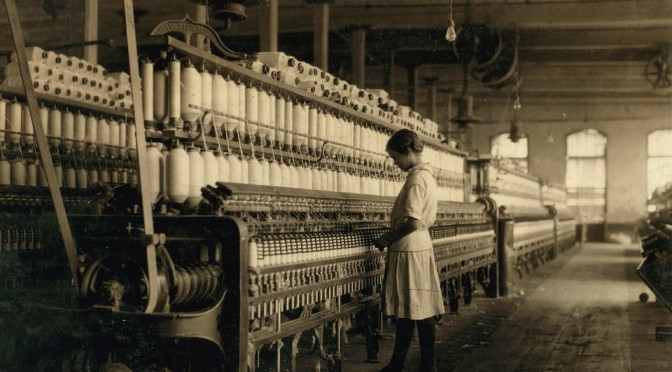
At the textile mill
After she’s hired at a textile mill, Lyddie works harder than ever. She’s seen by the other workers as a miser, since she carefully saves every spare cent she earns, intending to pay off the debt on her family’s farm and eventually move back home.

While the other women and girls in the factory talk about petitioning for a shorter, ten-hour work day, Lyddie is afraid of the idea of earning less money. She sees her roommates’ health deteriorate due to the terrible conditions in the mill, and she herself is being worked to utter exhaustion. But her determination doesn’t alter; she must earn as much as she possibly can to reclaim her family’s home.
I won’t spoil the ending for you. I’ll only say that it surprised me by not being the traditional, happy ending you’d expect from a historical fiction novel about a young woman.
Why Lyddie, by Katherine Paterson, makes the list
Although it’s written by a modern author, the heroine isn’t an anachronism. Many women found independence as factory hands during the industrial revolution. But Lyddie’s story, fairly typical of working girl, isn’t the inspiring success story you’d find on Oprah. Conditions in the mills are horrendous compared to today’s standards. Workers could expect 14 hour workdays, no safety regulations, and had no recourse for sexual harassment or abuse. Lyddie and her friends all sacrifice important elements of themselves for the freedom to earn a living. And, quite un-heroically, Lyddie refuses to protest for better working conditions for herself and her ailing friends, for fear of losing her position.
But Lyddie’s determination to be free and make her own way in the world is admirable. She’s a fiercely independent young woman, who scorns a marriage proposal, infuriated by what she sees as another request for ownership of her body and soul. Even after losing everything she worked for, she continues to carry on, in search of true freedom. Not an easy goal for a poor woman in 19th century.
Katherine Paterson’s research makes this story rich in history. And her writing makes it all feel real.
Order your copy of Lyddie, by Katherine Paterson today!
Did you read this book as a child? Use the comments below to share what you remember of it and how (or if) it shaped your views.


Leave a Reply