The American Spinster Review of Maxine Hong Kingston’s The Woman Warrior: Memoirs of a Girlhood Among Ghosts
“Perhaps women were once so dangerous they had to have their feet bound.”
The Woman Warrior is a spellbinding mixture of autobiography, family history, and girlhood fantasies. From the opening section, “No Name Woman,” the story of Kingston’s disowned aunt, to tales of her mother’s time as a village doctor in “Shaman,” Kingston’s book reads like a whispered confession.
As a daughter in a family of Chinese immigrants, Kingston struggles with the conflicting messages her mother gives. Daughters are worthless, slaves, maggots. And yet, her mother also told Kingston and her sisters stories of warrior women, like Fa Mulan. Stories of courageous women who avenged their families and fought better than men.
As a child caught between two cultures, Kingston struggles with her inability to speak for herself and her deep desire to be seen and understood. She knows that, although supposedly considered a worthless girl, she is also supposed to be a warrior and save her people. Who who people are, however, was a mystery to her.
Why It’s a Spinsterly Read
Kingston writes that she and her sisters made up their minds to learn science and mathematics, to never marry or be dependent on a husband, who might someday abandon them. Having grown up with stories of how hopeless their lives would be as girls if the family moved back to China, as well as stories of their mother’s independence as a doctor before she immigrated, they learn that they have to be able to care for themselves if they want to survive.
To avoid the arranged marriage her parents try to set up, she cooks poorly and breaks dishes to prove that she’s not good wife material.
“Even now, unless I’m happy, I burn the food when I cook. I do not feed people. I let the dirty dishes rot. I eat at other people’s tables but won’t invite them to mine, where the dishes are rotting.”
Even when the possibility of marrying is acceptable, she still determines that she won’t let herself be a burden or an excuse.
“No husband of mine will say, ‘I could have been a drummer, but I had to think about the wife and kids. You know how it is.’ Nobody supports me at the expense of his own adventure.”
Kingston’s Woman Warrior: Memoirs of a Girlhood Among Ghosts is an engaging, if unusual, read. Many women will be able to relate to it, regardless of their racial or socioeconomic upbringing. It taps into something fundamentally American, fundamentally female.
The American Spinster Review of Katherine Paterson’s Lyddie
Growing up, one of my favorite fiction writers was Katherine Paterson. She’s the children’s lit writer who created the Newberry Honor-winning The Great Gilly Hopkins, and the Newberry Medal-winning Bridge to Terabithia and Jacob Have I Loved. The less recognized novel that I’m thinking of today, however, is called Lyddie. It’s short; just over 180 pages, but the main character has stuck with me more than Gilly or Jess, or even Louise, to whom I so easily related as a child.
The Story
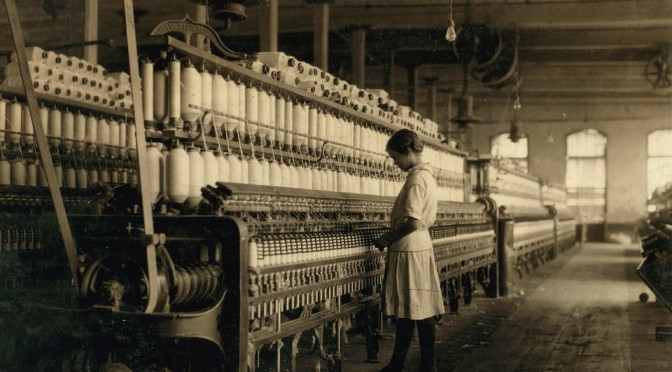
Lyddie Worthen starts out as a poor farm girl. Her father disappears after heading West, and her mother leaves their home to live with relatives a few years after. Lyddie stays with her brother to work the land, until their mother hires her out to work at a tavern.
Lyddie learns then what it’s like to live like “a black slave.” Her time is not her own, as she works long hours for no wages (all of her pay is sent to her mother). She gains nothing but meager food and board for her work, at least until the proprietress fires her for visiting her brother. Although Lyddie knows she doesn’t need to leave (the proprietress will forget in a day or two), she takes this as her freedom. Lyddie has heard that girls can earn a living working in the fabric factories of Lowell. Once freed, Lyddie heads south to find a job.
After she’s hired at a textile mill, Lyddie works harder than ever. She’s seen by the other workers as a miser, since she carefully saves every spare cent she earns, intending to pay off the debt on her family’s farm and eventually move back home.
While the other girls in the factory talk about petitioning for a shorter, ten-hour work day, Lyddie is afraid of the idea of earning less money. She sees her roommates’ health deteriorate due to the terrible conditions in the mill, and she herself is being worked to utter exhaustion. But her determination doesn’t alter; she must earn as much as she possibly can to reclaim her family’s home.
I won’t spoil the ending for you, except to say that it surprised me by not being the traditional, happy ending you’d expect.
Why It’s a Spinsterly Read
Although it’s written by a modern author, the heroine isn’t an anachronism. Many women found independence as factory hands during the industrial revolution. But Lyddie’s story, fairly typical of working girl, isn’t the inspiring success story you’d find on Oprah. Conditions in the mills are horrendous compared to today’s standards. Workers could expect 14 hour workdays, no safety regulations, and had no recourse for sexual harassment or abuse. Lyddie and her friends all sacrifice important elements of themselves for the freedom to earn a living. And, quite un-heroically, Lyddie refuses to protest for better working conditions for herself and her ailing friends, for fear of losing her position.
But Lyddie’s determination to be free and make her own way in the world is admirable. She’s a fiercely independent young woman, who scorns a marriage proposal, infuriated by what she sees as a request for ownership of her body and soul. Even after losing everything she worked for, she continues to carry on, in search of true freedom – not an easy goal for a poor woman in 19th century.
The American Spinster Review of Amanda Palmer’s The Art of Asking.
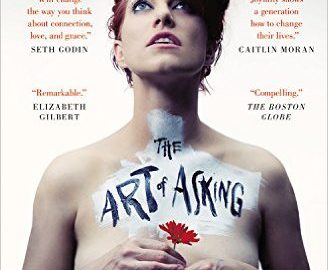
“Take the f*cking flower!”
I should confess, I have been a devoted fan of Amanda Palmer for years. Since 2004 when I first heard of the bizarre and yet inexplicably familiar sound of her band The Dresden Dolls, I’ve been in love. Fan-love, that is, not creepy-stalker-fan-love. Just unadulterated adoration of an artist and her art.
Sometimes it’s hard to find the line between safe fan-love and creepy-stalker-fan-love when looking at The Dresden Dolls/Amanda Palmer fan base. From the outside, it’s all pretty unusual. Palmer couchsurfs and hitchhikes with her fans via Twitter, encourages them to ask her personal questions, and even allows them to draw with Sharpies on her naked body. This has led to a bond between artist and fans that outside observers often have a hard time understanding.
Fans who followed her long battle with her record label know how she tried to explain her brand of ‘marketing’ to them, and how the label just didn’t understand (actually connecting with fans on a personal level? Madness! This cannot lead to record sales). Palmer has been raked across the coals of social opinion for daring to have a wildly successful Kickstarter campaign, and even occasionally criticized for marrying celebrity author Neil Gaiman. Yet her 2013 TED Talk was so popular, it lead to a book deal.
In The Art Of Asking, Palmer demonstrates that asking for things isn’t the same as begging, and receiving isn’t the same as scamming. She explains that trust and asking are intimately, inseparably connected. Asking makes you vulnerable. You just have to trust.
Why is this of spinsterly interest? Because tied up with album costs and fan interaction is the issue of independence. Palmer talks about her marriage to Gaiman (whose proposals she refused for years before finally accepting), the public perception of it, and about the difficulty that she, Queen of Asking, had in asking her husband for help.
The book is intensely personal and open, much like Palmer’s direct interaction with her fans. It can be an emotionally challenging read at times (and this coming from someone who followed her intimate, emotion-laden blog for years). But when I turned the last page, I found it well worth the personal investment.
Many proudly independent women will be able to relate to Palmer’s journey and growth. In fact, many people in general will be able to relate. That’s because it’s fundamentally a book examining the trust and intimate exchanges involved in the often difficult task of Asking. If nothing else, it’s a rarely seen view on the matter, and worth a read for anyone.
The American Spinster Review of Ann Pachett’s This Is the Story of a Happy Marriage
I first heard of this book sitting in my car listening to NPR. I was on my lunch break from the grocery store, where I worked with some of the best co-workers I’d ever had. All but one were married women, and even the unmarried one planned to have a husband and children one day. Any spinster-by-choice knows what it’s like to be friends with moms-by-choice. There’s a gap of understanding that, no matter how fond you are of each other, will never really close.
So, that day, waiting for my 30 minute break to be up, I turned on the car radio. The NPR program had only just started. Though I’d never heard of Ann Patchett before then, after listening for just a few minutes I knew I had to read this book.
Review This Is the Story of a Happy Marriage is a collection of non-fiction essays, articles, and speeches written by novelist Ann Patchett. Don’t let the title fool you; Patchett may include the story of a happy marriage, but the book is also largely about being a happy, unmarried, independent woman. From a young age, Patchett saw most marriage around her ending in divorce. Throughout the articles, she describes her family history of divorce (her parents were each divorced at least once, her grandparents, and even great-grandparents had been divorced), the divorces of her friends’ parents, and her own divorce (her first marriage lasted a very difficult 14 months). Ultimately, she realized the only way to “beat the system” was to never marry.
In the titular story, Patchett recounts the 11-year courtship that ultimately led to her second marriage. It may be the story of a happy marriage, but it’s also, in some ways, a blueprint to having a happy relationship. “[N]ot being married had saved us. Had I said yes to Karl’s initial proposal… I don’t think we would have made it. By not living together, we could fight and then step away to cool off. I would think at least we’re not married, which is so much better than thinking, I can’t stay married to you.”
Despite the fact that her boyfriend Karl had wanted to marry her from the outset, she remained firm. “[H]ow could I, who carried divorce in my veins all the way back to Denmark, be absolutely positive that it wouldn’t happen this time? … no matter how much I loved Karl, I wasn’t naive. And I wasn’t getting married.”
Of course, they do get married, after 11 years. They marry because they learn that he has a terminal heart condition. As a spouse, Patchett would be able to care for him and make decisions that she couldn’t make as a girlfriend. She sells her house, they marry, and she laments not marrying long ago, before the love of her life was dying. It was Karl who assures her that it was “exactly the right time.”
Other stories in the book speak to the childfree woman. Patchett writes about her dog, Rose, and how she doted on her. She kept pictures of Rose in her wallet, stayed home with her all day, left her with a baby sitter when she needed to run errands. Patchett writes,
“Look at that,” people said, looking at me but not Rose. “Look how badly she wants a baby.”
A baby? I held up my dog for them to see, my bright, beautiful dog. “A dog,” I said. “I’ve always wanted a dog.” The truth is, I have no memory of ever wanting a baby. I have never peered longingly into someone else’s stroller. I have, on occasions too numerous to list, bent down on the sidewalks to rub the ears of strange dogs, to whisper to them about their limpid eyes.
Others insisted that she really wanted a baby, sometimes going so far as to suggest she simply didn’t realize that’s what she was really yearning for. In the NPR program, Patchett uses the analogy of missing keys.
It would be like if somebody said, “Your car keys are in the drawer.” And you go and you open the drawer, and not only are your car keys not in the drawer, there’s nothing in the drawer. The drawer is empty. And you come back and you say, “The keys aren’t in the drawer.” And they say, “no go back and look again. They are in the drawer.” And you go back and you open the drawer and it is empty. And that’s how I always felt. Like people were always saying to me, “Go back and look again. Examine the inner contents of your heart, you will find it.” And I never did.
For the happily unmarried, happily childfree woman, reading Patchett’s collection is like finding a kindred spirit. At last, someone who understands! Someone who realizes that I’m not in denial, I’m not afraid. I just don’t want what I’m supposed to want.
Summary
Although the book at times seems like an unusual combination of autobiography and instructional essays, it’s a captivating look at the author’s life. Perhaps its fitting that the topics vary so widely, since in Patchett’s life, business and home life, personal journeys and public publications, are so closely entwined. This Is the Story of a Happy Marriage will be a welcomed read for anyone who is happily unmarried, or happily childfree, but is also a wonderful introduction to the spinster lifestyle for those who are uninitiated. I recommend reading it, and I recommend giving it to friends and family who don’t yet believe that anyone can be truly happy in this lifestyle. Ann Patchett makes our case well.