Why Do Childfree Women Hate Moms?

Mombies. Breeders. Trash. Stupid. Entitled. Why do childfree women hate moms?

Do Childfree Women Hate Moms?

The title might seem a little clickbait-y, but it’s a question I’ve had to ask myself over the last couple of years. Since seeing more of the online childfree community, I’ve seen the absolute disgust many childfree women have for mothers. It’s brutal. And it’s left me wondering, time and again, why?

Why do childfree women hate moms? | The American Spinster

You may disagree with me on this, but in my experience no one obsesses over the wrong-ness of someone else’s life unless it’s harming them directly or touching a nerve. Now, random mothers on the internet aren’t directly affecting childfree women’s lives.  At best we can claim they’re hogging resources for their children, that’s nothing compared to the disproportionate resources very wealthy individuals are using just on themselves.

So what is the real reason childfree women hate moms so much?

Mom-Bashing on the Internet

I come across some pretty hate-filled speech when I visit childfree groups. Besides the name-calling (breeder, mombie and crotch droppings for kids), I see posts filled with reasons that mothers are disgusting, gross, entitled, and trash. Any post that contains some sort of pain, discomfort, or unhappiness for a mother is met with more than a few words of delight. She deserves it, the stupid breeder.

And maybe you’re thinking, “Lils, it’s the internet. If you can’t handle hate talk, don’t log in.” And that would be fair. But my quest here isn’t to rid the world of impolite people on the internet. It’s to find out what is really at the bottom of this surprisingly vicious and unending anger toward moms.

Why do childfree women hate moms? | The American Spinster

Why the obsessive interest in moms?

It looks like childfree women are paying a lot of attention to a lifestyle we supposedly don’t care about. And sure, if you’re social media friends with a pregnant woman, you’re going to see posts about her pregnancy. And if you hate kids and pregnancy, it’s going to upset you. I also understand that many people keep contacts they don’t particularly like on the friends list. But… why follow them? Why keep up with their apparently distasteful lives?

Why create online spaces that help childfree women hate moms?
Get the FREE ebook, "How to Have a Meaningful Life without Kids"

Are Moms Just Easy Scapegoats?

When you get right down to it, moms aren’t hurting us or cramping our style more than other groups. It is distressing to see the horrible ways some mothers treat their children. And it can be annoying to see mothers getting so much attention. But, that’s a lot of anger for such common crimes. Is it simply the fact that this is the internet, and being mildly annoyed at someone can translate to unreasonably angry speech?

All of it looks–to me–like a basically baseless hatred. The kind we need to hang on to to keep from looking more closely at something in our own lives or society. And so we make moms the “other.” We find their lifestyle gross, so we call them disgusting. We think they’re dumb for no knowing motherhood would be so taxing, so we call them brainless mombies. And, like any type of resentment-based, illogical anger, we back it up with ‘proof’ that they’re hogging resources and overpopulating the planet. They deserve our hatred.

Pardon My Soap Box, But…

So why the heck do I care so much about the way childfree women hate moms?

Because being childfree wasn’t always a choice for me. I grew up in a very conservative church group where birth control was never discussed. It could only be whispered among married couples who already had a few children.

I had no sex education whatsoever. And I definitely didn’t have the means to get any kind of birth control. I mean that. There was no possibility of me even going into a pharmacy on my own, much less coming home with condoms. If I’d ever had sex as a teen, there would have been no way I would have been able to use protection.

Why do childfree women hate moms? | The American Spinster

So, when I read comments like, “That stupid twat knew what she was getting into,” I think, “Did she?” Childfree women, overall, seem very educated about pregnancy and childbirth–which is probably part of why we opt to be childfree. But no-one (I mean literally no-one) ever told me about any of it when I was growing up.

My experience isn’t usual. A lot of kids grow up in similar situations. It’s easy for a childfree woman with unrestricted internet access to look down on teens and young, insulated adults for not knowing better. But when your school, parents and church refuse to discuss the realities of sex, childbirth, or birth control, how are you supposed to learn about it?

Despising the Less Fortunate

This is the case for most of the unhappy mothers I know. I imagine it’s the case for most unhappy mothers, period. They were herded into a lifestyle they didn’t choose freely (if you don’t know there are options, you can’t make a choice). They’re stuck in a society that idolizes birth but devalues mothers. They lose their selfhood in service to their kids. At times, they try to take pride in this martyrdom. And sometimes they turn to social media to vent their frustrations.

Childfree women, on the other hand, have lives we supposedly love. But we talk viciously about women who ended up in lives they don’t even like. Don’t misunderstand me, we need to vent our frustrations at times, too. And not every action we take has to be some glorious, altruistic move.

But maybe, instead of ranting about how much moms disgust us, our time would be better spent trying to reach young girls and women to let them know that they have other options.
Why do childfree women hate moms? | The American Spinster

Does this ring true for you? Tell me about your experiences in the comments below.
If you’re uneasy with the way childfree groups are often flimsy disguises for anti-procreation groups, I recommend checking out Respectfully Childfree.


Images provided by Kaboompics

How to Use Free Time as a Childfree Woman

If you don’t have kids, you’re supposed to have tons of free time on your hands. So why are you always struggling to find time for the basics? In this post, I’ll show you how to use free time wisely as a childfree woman.

Why You Don’t Have Kids or Free Time

Childfree people are rolling in piles of money, get at least eight hours of sleep per night, and have hours upon hours of free time. Right?

I mean, that’s certainly the image both happily childfree people and resentful parents like to believe in. But if you’re like most of the childfree people I know, that definitely doesn’t describe your life. I’ll tackle the ideas about wealth and good rest another day. Today I’m talking about the relationship between a childfree person and her free time.

Why don't you have more time?

How to Use Free Time as a Childfree Woman

You’ve probably heard the stories about how dedicated mothers found–or made–the time they needed to manage their careers while juggling an armful of after-school activity schedules, keeping house, and helping their kids with homework. Meanwhile, you can’t seem to manage your meager to-do list with one job and no kids. What gives? Are all those supermoms liars? Are you just lazy?

There’s a reason that you, childfree person who supposedly has tons of time, don’t make productive use of your time. You might not like to hear it, but it could change your life. You can’t get anything done because you don’t have enough to do.

Before you close this tab, hear me out. This post is for you. No matter how overwhelmed and behind schedule you are, it’s because you aren’t doing enough to need a decent schedule. So, let me explain how to use free time by getting rid of your free time.

Schedule your day like a mom.

Dr. Ana (Psychology with Dr. Ana) discusses something similar in her video, “How doing MORE healed my burnount (it’s not as toxic as it sounds).” While it sounds contradictory (or worse, pro hustle culture), I promise it makes sense.

The Secret’s in the Schedule

You’ve scrolled past the video tutorials about how busy momtrepreneurs schedule their day. Now I’m going to tell you how to use their tips to your advantage. The reason some moms can manage so much while you can barely keep your kitchen clean is plain. They have no choice. You do, so you need to choose to make the most of your free time.

As motivational author Jen Sincero* has said, “If you feel like you have all the time in the world to do something, you will take all the time in the world.” This lines up with Parkinson’s law, which Dr. Ana references in her video: “Work expands so as to fill the time available for its completion.” This is why scheduling can be incredibly beneficial — it keeps a single task from filling up an entire day.

Listen. There are days when I go to work and I literally have one goal when I get home. And I don’t get it done. Yet I still go to bed exhausted. Then there are days when I have 10 different tasks to do between 5:30 and 8:00, and they all get done on time. With a set amount of time, I need to make decisions about how I’m going to go about each task, and I need to make those decisions quickly. That keeps a small chore from becoming a massive project.

Now, if you’re thinking, “Lills, I can’t find the time I need to get my clothes ready for the next day. Writing things on a calendar won’t help,” listen closer. Using a schedule is just like using a budget. In fact, they’re the exact same thing. One shows you how to budget your money so you don’t blow it all, and the other shows you how to budget your time so you don’t blow it all.

It’s true that schedules don’t work for everyone, and people with neurological conditions such as ADHD may struggle to use traditional time management tools. But that doesn’t mean there isn’t a time budget that will work for you. Jessica McCabe, of How to ADHD, has some amazing resources that could change your life.

Enjoy your free time as a childfree woman | The American Spinster

How to Set Up Your Single, Childfree Schedule

Making your schedule doesn’t need to be a horrible chore. And using your schedule shouldn’t feel like living in a boarding school. Just like a financial budget, your time budget is here to let you live the way you want to. It’s going to give you control over your time.

To get started, you’ve got to:

Track Your Time

In How To Live On 24 Hours A Day, author Arnold Bennett** challenges the reader to account for their time. If you spend 10 hours a day commuting and working, and 8 hours a night sleeping, where do the other 6 go?

This is usually the first thing you do when you get ready to make a financial budget, too. You’ve got to track your spending to see where your money is going. Only then can you identify the areas you can improve. When you find out where all your time is going (Netflix, scrolling through Instagram instead of brushing your teeth, etc), you’ll at least be able to see the real reason you don’t have time.

Remember, there’s nothing wrong with chilling in front of your laptop. But if you want to see how to use your time well, you’ve got to…

Make a Schedule

If you already have a calendar app you like, great. If not, use the one your phone came with, or download a free program like Evernote. Then fill in every single hour of your day. My schedule usually looks like this:

  • 5:00-5:10 – Bed yoga
  • 5:11-5:19 – Get dressed
  • 5:20-5:29 – Eat breakfast
  • 5:30-5:39 – Feed pets

Then I spend the next chunk of time commuting and working. My schedule after getting home is much more relaxed, but no less filled. It includes:

  • Eating dinner (20 minutes)
  • Watching Netflix (55 minutes)
  • Writing for The American Spinster (1:15 minutes)
  • Playing with pets (20 minutes)
  • Getting clothes and lunch ready for tomorrow (15 minutes)

Some of these things overlap. For instance, I usually play with my cat and prepare my lunch while I have Star Trek playing.

No Kids and No Free Time

Schedule Blank Time

I also schedule blank time, or time with no specific purpose. These slots are usually only 5 or 10 minutes long and happen in between more definitive activities. I can use these time slots if something takes longer than I planned, or if something unexpected, like a phone call, comes up.

Some times I have a completely blank hour. But I also have a list of unscheduled items I need to do. For instance, I know that some time during this week I need to write and mail thank-you notes. When I find myself with a blank time slot, I’ll look at my list, see that, and do it.

Stick to It

It should go without saying, but it’s so important I’m going to remind you. You’ve got to stick to your schedule. Changing your schedule when something comes up is fine. Cheating on your schedule is self-sabotage. Again, this can be especially difficult for people with ADHD or other disabilities. Find the method of reminding yourself that works for you.

If you want to learn how to use free time wisely, you’ve got to trust me on this. Use a schedule, and stick to it.

Get the FREE ebook, "How to Have a Meaningful Life without Kids"

Whether you’re childfree by choice or by chance, you’ve got time that women with kids lack. Use it like the gift it is.

Do you suffer from self-imposed guilt over not getting more done in your free time? Are you ready to start taking advantage of the childfree lifestyle? What scheduling program, if any, do you use? Let me know in the comments below.

Notes

* Jen Sincero’s Badass books helped me think about money in a much more positive way. However, there are plenty of valid critiques of her work, including that much of her advice only applies to people who already have a certain amount of privilege (like me). Some of her earlier work is also click-baity at best and downright harmful at worst. If you’re interested in learning more, SAVY WRITES BOOKS has an entire playlist dedicated to her work.

** I think looking at Arnold Bennett’s work is important, as it has laid the foundation for a lot of self-help/time-management books that have followed. Like many resources, there are a lot of thought-provoking ideas in How to Live on 24-Hours a Day. But it severely downplays the fact that we don’t all have the same level of flexibility to manipulate our schedules. Poor people are far more at the mercy of systems designed to maximize profits for shareholders, not time for individuals and communities.

As with everything, if you choose to read any of my sources, read them critically.

Images provided by Kaboompics

Buying Gifts for Your Nieces & Nephews

So you’ve got to pick out a cool present for one of your sibling’s kids. But you don’t have the slightest idea what’s popular with the young ‘uns these days. Never worry. Here’s the childfree woman’s guide to buying gifts for nieces and nephews.

How to Get Your Nibling a Great Gift

One of the earliest posts I ever wrote for this blog is “How to Be the Cool Aunt.” In it, I talk briefly about buying gifts for your nieces and nephews. I mentioned that you should focus on gifts that:

  • Aren’t too expensive
  • Are based on their interests
  • Encourage them to think creatively

Today I’m going to explain this in a bit more detail.

Your Role as the Gift-Giving Cool Aunt

My cool aunt always got us nice gifts. Not ridiculously expensive, but not cheap either. But what made them especially nice was how well they seemed to suit me. For a woman who only saw me for a few minutes once a week, she really seemed to understand what I liked.

The fact that she didn’t have children probably made it easier for  her to pay attention to what my cousins and I really wanted.

The Childfree Aunt's Guide to Buying Gifts for Nieces and Nephews

3 Tips for Buying Gifts for Your Nieces and Nephews

The best gift you can give to anyone is a gift that makes them feel seen and understood. The price tag and cultural relevance (i.e., the season’s hottest toy trends) are less important. So when it comes to buying gifts for your nieces and nephews, choose something that:

1. Isn’t too expensive

The goal here is to focus on the quality of the gift as it applies to the kid. That will probably mean spending a little money, but your job isn’t to get the expensive new gaming system. Leave that to parents and grandparents.

2. Relates to their interests

This is where you can really stand out. As I mentioned in the earlier blog post, parents are used to their kids. They tend to see them through the ideas they developed years ago. Even if the kid’s interests have changed or their personalities have continued to develop, parents can be slow to see it.

The trick to buying gifts for your nieces and nephews is to get something that wasn’t on their list, but does meet their interests. Pay attention to them. What do they love to talk about? See what kinds of toys or activity books you can find on the topic, even if it’s weird. If you have a niece who really loves looking at Pottery Barn catalogs, get her an Interior Design Sketch Portfolio.

{Pst! That’s an affiliate link. There are going to be a few more throughout this post. You can see my affiliate disclaimer here.}

The Childfree Aunt's Guide to Buying Gifts for Nieces and Nephews

3. Encourages creativity

When buying gifts for your nieces and nephews, make sure you look for an “active” gift. The design sketch portfolio above is a good example, because it gets them to think and design. Building sets, crafts supplies, and nature journals are other good choices. Passive entertainment is fine, but if you want to be the cool aunt, go for the gift that helps them discover new things about themselves.

Get the FREE ebook, "How to Have a Meaningful Life without Kids"

So you’re looking for a reasonably priced gift that sparks their interests and encourages them to think, design, and create. It’s a tall order, but it’s worth the effort. Below are a few of my best sources for finding a gift that meets those criteria.

Gift-Buying Resources

If you’re not sure where to start, here are a few tried and true Cool Aunt gifts:

Science kits

Generally I find most “science kits” to be a little too heavy-handed for my taste. You want something that will help them learn, but you don’t want it to seem like an educational gift. However, if you spend a little time you can find some really fun gifts, such as this Grow ‘n Glow Terrarium. It comes with fast-growing sprouts so your niece or nephew can learn about plant biology in a controlled environment with little to no adult supervision.

Building kits

Once your nibling has developed their fine motor skills, they’ll love building sets. There are so many types to choose from, but one of my favorites is this Marble Run building set.  It’s simple and intuitive, and it teaches kids all about motion, gravity, and design. My brother and I had one when I was little, and we played with it all the time.

If you want something a little more advanced, try the Glow in The Dark Roller Coaster Building Set. It operates on the same principle, but it offers more complexity and a defined theme.

Buying Gifts for Your Nieces and Nephews | The American Spinster

Simpler Toys

My cousins and I had lots of Colorforms to play with when we were kids. And while that company is still around, Melissa & Doug seem to have some of the best “reusable sticker” playsets at the moment. Like this cute little Chipmunk House.

These are quiet toys that don’t require a lot of physical energy. They need zero setup; just open the book and start placing your stickers. They’re basically like paper dolls, but more durable and colorful. Because there’s no script or rules to follow, they still encourage plenty of creativity. A puffy sticker playset is perfect for more reserved kids.

Ready to Cement Your Status as The Cool Aunt?

Based on my experience, if you follow these guidelines when buying gifts for your nieces and nephews (or cousins, little sibs, etc), you’ll quickly get a reputation for giving the best gifts. And that’s important because kids need to know that there’s someone paying close attention to them. Parents get overwhelmed, especially when they have multiple kids. Holidays and birthdays are your chance to tell your nibling, “I get you, kid.”

Was this a helpful list? Were there any good tips I left out? Let me know in the comments below.

Buying Gifts for Your Nieces and Nephews

All images are provided by Kaboompics.

Spinster, Don’t Fear the Reaper | Why I Don’t Fear Dying Alone

I’m not afraid of dying alone.

If you’ve followed this blog, you might be thinking, “Lils, that’s easy for you to say. You’re not really alone. You’re in a living-apart-together relationship. You’ll have someone there when you get old.”

But the truth is, that’s probably not going to be the case. Given the significant age difference between my partner and I, it’s likely  I’ll spend the last decade or more of my life alone.

But this honestly doesn’t scare me. And I’ll tell you why.

But before that, I want to give you some honest tea: Writing a blog series on spinster death was hard. Not because I had to face my own mortality (I already had my advance directive and burial plan). But because I had to face the fact that I might actually end up dying alone. Not alone as in, “All my friends are dead,” but alone as in, “My friends are still alive and no one wants to be there for me.”

Who Will Take Care of Me When I’m Old?

When I made my advance directive, I asked my LAT partner if I could name him as my healthcare proxy.  He said he was uncomfortable with that. He didn’t want to be the one to “pull the plug.” That was reasonable, so I turned to the next person I trusted most.

My best friend is two years younger than I am and in good health, so she had a reasonable chance of outliving me. But her beliefs about end-of-life care don’t always sync with mine, and I had some reservations about how ethical it would be to ask anyone, even my bff, to do something (i.e., pulling the plug) that might violate her own ethics.

I could have asked my grandmother, and I believe she would have accepted. She would definitely have followed my wishes. She and my late grandfather both wrote living wills to ensure they’d have natural deaths. And, when my grandfather became terminally ill, she defended his right to die at home when he could no longer advocate for himself.

But the odds of my grandmother outliving me were low. Besides, she’d already had to do that for my grandfather. Wouldn’t it be pretty rough to have to argue with doctors to allow her young granddaughter to die? I didn’t ask her. It seemed wrong.

Honestly, realizing I had no close friends or family willing to do this for me made me feel very lonely. For a few, brief moments I wondered if all the dire warnings about dying alone might have been legit. It was a pretty tender spot for a bit, and I wondered how (or if) I’d address it when it came time to write this series. Would I have to admit that, after all, this lifestyle could mean dying alone and unloved?

Spinster, Don't Fear the Reaper

Married Couples Fear the Reaper, Too

It didn’t take me too long to realize that, in fact, this was not a spinster problem. Few people, at least few Americans, are comfortable with death. It’s especially weird for a younger person in good health to fill out an advanced directive. I asked myself, if my S/O and I had been married, would he have been any more comfortable accepting that?

Answer: Of course not. Getting married doesn’t suddenly make you chill with Death and the thought of losing a loved one. After thinking about it, I realized the only reason this process is different as a single is because you actually have to sit down and talk about it.

If my S/O and I were married, he’d have automatic power of attorney. But he’d still feel uncomfortable in that role.

Realizing that made me feel less alone and unloved. Death makes people uncomfortable. Handling medical issues for a sick and unconscious person is uncomfortable. And being tasked with pulling the plug is, for most people, really uncomfortable.

Nonetheless, it left me with an important question: What will keep me from dying alone?

But Seriously, Who’s Going to Take Care of Me?

Let me quickly say that at no point did getting pregnant, having a baby, and binding that child to me through filial obligation and guilt in order to coerce them into performing these tasks for me seem like a good way to avoid dying alone.

For the time being, I’ve named my dad as my healthcare proxy. As I’m only 32 and in pretty good health, it’s unlikely he’ll have to fulfill that role. In the future, I’ll likely update it. At the moment, I don’t know who my new health care agent will be. But I feel better with that uncertainty that I’d feel as a mother wondering if I could count on my kids to care for me. Wondering if they would respect my wishes, or if I would, like so very many mothers, end up abandoned in an assisted living facility or left to slowly die alone in hospice.

The Single Woman's Guide to Dying Alone | The American Spinster

Why This Spinster Doesn’t Fear the Reaper
(Or, the reasons I’m not afraid of dying alone alone)

First, I’m not afraid of languishing in a nursing home, neglected by underpaid and frustrated staff.

I’m laying money aside for my own care in my later years. I’ve got a living will, and I’ll continue to update it as I age and my life circumstances change. Instead of paying some $235,000 (or whatever the current cost of raising a kid, sans college, is) on raising a child, I’ll put that toward my end-of life care.

Again, it goes without saying that none of us knows the future, and even the best-laid plans can go awry. But that’s true for everyone, not just single people. I have seen too many people of moderate means with large families propped in a corner of a senior center, forgotten by the outside world to believe that I’d be immune to these troubles if I weren’t single.

Second, I’m not afraid of being alone.

I don’t see myself as being so unlovable that I won’t have any friends. I talked about hiring a death doula in the last post, which is yet another reason I’m not worried about what will happen if all my friends and family die before me.

Third, I’ve prepared.

You might think it’s tacky of me to talk even more about money, but you can’t have an honest discussion about death without addressing this issue.

Our grandmothers learned the importance of financial independence within a marriage, so they would never be left stranded should their husbands leave. They held part-time jobs and kept their nest eggs. Our mothers learned the importance of having a good-paying job before (and often during) marriage. And we’ve learned the importance of truly standing on our own two feet. Equal to—not dependent on—a partner.

As long as we live in a world that runs on money, finances are vital to self-reliance. Feeling too ashamed to save up for yourself just makes you a burden to someone else later. Taking charge of your own finances, career, life, and death is empowering.

Why I Made This Series

It’s not because I fear death that I make plans for it. This is hard for me to explain to some people. Some of my friends insist that I’m worried about dying, but they couldn’t be further from the truth. I think they’re worried about death because they refuse to look at it.

Planning for death isn’t like planning for a worst case scenario. You’re going to die. Avoiding death preparation is like knowing that you have a conference in another state and refusing to get a plane ticket, pack your clothes, or make arrangements for your pets. The person who does all of these things in advance isn’t worried; they’re just sensible.

Don’t worry about dying alone. Do future-you a favor and make arranges for your own end-of-life care today.

A Single Woman's Guide to Death

Designing Your Death as a Single Woman | A Spinster’s Guide to Death

‘Designing your death?’  you may be thinking. ‘Is she really writing a blog on how to die as a lonely, old woman?’ Don’t worry, I’m not. I’m simply telling you how you can plan for your death so you won’t fear dying alone.

Contrary to popular belief:

  1. You don’t need to get married and have kids to avoid dying alone.
  2. Getting married and having kids won’t prevent you from dying alone anyway.

I touched on this in the last blog, but the jist of it is this: Spouses die. Children bail. As I’ve said before, you’re not so unloveable that only a ring on your finger and a bun in the oven will save you from dying alone. You have, or can have, friends and family who love you and will stay by your side when the reaper comes calling.

{This post contains links to death-positive resources. Please read my affiliate disclosure here.}

But What if You Are Alone?

What if, when your time comes, you’ve outlived all of your close family and friends? If the vision of lying abandoned in a sterile room, gasping out your last is clouding your vision, relax. Let me take you through a recent discovery of mine that may change the way you feel about dying ‘alone.’

Personally, the thought of being surrounded by my loved ones as I leave this world isn’t actually a comforting one for me. I know it sounds strange, because dying alone is such a deep-rooted fear in most people. And while I wouldn’t want to necessarily die alone, dying before an audience is—for me—the worse of those two extremes.

I don’t want to spend my last moments nervous and uncomfortable, trying to comfort other people. So what’s the solution for someone who doesn’t have anyone left, or who simply wants to be cared for (instead of doing the caring) on her death bed?

Designing Your Death with a Doula

As I was preparing this blog series, a new upload to the Ask A Mortician YouTube channel showed me a third option.

I’d heard the term “death doula” in Doughty’s book Smoke Gets In Your Eyes, but I hadn’t paid much attention to it. But listening to Alua Arthur explain what she does, I felt an overwhelming sense of recognition. “Yes,” my mind seemed to tell me. “That’s what I want my death to look like.”



I know many people will look at the idea of hiring someone to show you kindness in your final hours as a pitiable situation, but I don’t. Caregiving is a valuable service. I’ve advised people to consider the possibility of hiring a caregiver rather than raising a child in the hope that it will one day care for you in your old age. I also love clear expectations and interpersonal contracts. So the idea of hiring a death doula to take care of me in a way that will make me comfortable (rather than the way that will make my family feel comfortable) looks excellent.

Designing Your Death | The Single Woman's Guide to Death

Now, at the moment, my death plan doesn’t include anything like this. I’m still in my early 30s and, thankfully, in good health. So if I’m to die soon it’ll likely be due to an accident. When I get older, or if I find out I’m dying due to illness, I’ll hire a death doula.

How to Go About Designing Your Death

In the last post, I talked about making your advance directive and formal arrangements for your funeral. You can include all of the plans you make for your end-of-life care in your advance directive. But before you write that all in, you’ve got to decide what you want.

This blog is simply about designing your death. Think about what you want it to look like. Is your family surrounding you? Are your pets there? Are you at home, in a hospice center, or somewhere else? Remember that you might not be able to express yourself when the time comes, so it’s really important to plan ahead and write everything down.

Take a few minutes (or a few days) to imagine what you want your final hours to be like. When you know what you want, tell the person who can make those arrangements (your power of attorney or healthcare proxy, usually).

Selfish, Even in Death

“We should only think of ourselves in this life, of our own death.” – The Phantom of the Opera by Gaston Leroux

As a single person without children, I’ve been called selfish many times for many reasons. And someone will probably say that it’s selfish of me to make all of these decisions myself instead of letting my family handle my death as they want. And maybe choosing to die the way I want is actually selfish. Maybe excluding my family from my deathbed is an unkindness to them. But, because I wouldn’t begrude anyone I love the opportunity to die as they like, I won’t withhold that from myself. Death is the one thing that has been guaranteed to me in life, and I believe it’s a deeply personal event. To me it seems more personal than getting married, having a baby, or even being born.

The way I see it, designing your death the way you want to is your right. More than that, it’s liberating. It takes a little bit of background anxiety out of your life.

What do you think? Is this just morbid, or is it an act of self-determination? Let me know what you think in the comments below.

If you’re still a little uneasy about the idea of dying alone, stay tuned for the final installment of A Spinster’s Guide to Death, coming out on October 31st.


Designing Your Death | The Single Woman's Guide to Death

How to Plan Your Death | A Guide for Single Women

You know why you need to plan your death as a single woman. But do you know how? In part 2 of A Spinster’s Guide to Death, I’m going to tell you how to plan your death as an unmarried, childfree woman.

Why This Is a Must-Read Blog

Let me be clear. You could go get a book on estate planning to learn how to plan your death. In fact, just about any estate planning book would give you more of the nitty gritty details than this blog post will. The only reason I think I’ve got something of value to say on the matter is because I’m writing specifically for single, childfree women.

The solo death is a sad one in our society. It’s so feared that some of us prefer to ‘settle’ than to risk dying alone. But let me tell you, it’s all a sham. If you’ve ever visited a nursing home, you know that it doesn’t matter how many husbands you have or babies you pop out. Anyone can die alone. And, in my opinion and individual experience, it’s the women who depend on others to care for them in their old age who are most likely to end up abandoned.

Caitlin Doughty talks about the fear of dying alone in her “Ask a Mortician” YouTube series:

As a solo woman, you actually have an advantage when planning for your death. And not just because you get to avoid the drama of leaving your estate to your children or making sure your spouse doesn’t get your inheritance. It’s because you get to make your own decisions instead of hoping someone else will do everything for you. As I mentioned in Part 1, there’s a lot of comfort in that.

How to Plan Your Death

When it comes to estate planning as a single woman (if you’re thinking, “Estate planning? I don’t have an estate,” listen. Even if you’re poor as a church mouse, you’ve got to plan your living will and make arrangements for your pets and your own funeral. That’s estate planning), there are really only three main documents you need to prepare.

But before we dive into this, I recommend you:

  • Make a cup of tea
  • Get a notebook or open a word file
  • Sit down in bed

Learning how to plan your death isn’t going to be as nerve-wracking as you think. I promise. Planning your death is like doing your budget: You can make yourself sick worrying about it, but once it’s done you feel far more in control of your life (even if your checkbook is in the red).

How to Plan Your Death | A Guide for Single Women

{Let me put a quick disclaimer here. I am not an attorney, a financial adviser, or involved in the death industry. This guide is simply meant as an introduction to and a jumping off point for planning your death as a single woman.}

#1. Advance Directive (Living Will)

No matter who you are, you’ve got to arrange your advance directive. But if you’re a single woman, you’ve really, really got to set up your advance directive. I talked about why this is important in Part I, but here’s a quick recap: You can’t just depend on your (non-existent) spouse to figure out your wishes once you’re incapacitated. For that matter, you can’t really count on your parents or next-of-kin to do what you want, even if you have made your wishes clear (and let’s be honest, most of us haven’t). I don’t know about you, but I don’t want to be in a coma while my family (including those members who don’t like me) squabble about whether or not to pull the plug. That is my decision.

#2. Pet Trusts

Pet Trusts | How to Plan Your Death

I wish I could tell you I’ve cracked the code on writing water-tight pet trusts but… I can’t. The truth is they’re complicated and they vary from state to state. But if you’re not familiar with the concept, here’s the jist of it.

Setting up a trust is kind of like taking a little piece out of your estate and setting it aside. When you die, anything that’s in a trust can go to whomever you’ve left it to right away. It doesn’t have to go through probate, which, in the case of a pet trust, means your pet isn’t hanging out in limbo.

What makes pet trusts a bit trickier than a money-only trust is that you’ll probably want to include your pet (legally considered a piece of property), money (if you have it) and some explicit instructions on who gets the money and how they can use it. Let me show you a few scenarios.

Scenario 1

Let’s say your best friend has agreed to take care of your cat should you die. You want to make sure your cat gets the right treatment, so you figure how much money it’ll take to care for your pet (food, grooming, vet bills, etc) and include that in your pet trust. You decide to name an executor (usually a lawyer) to be responsible for the money. The executor distributes the money in yearly or monthly increments instead of giving it to your friend in a lump sum. You include specific details regarding how often your cat should be taken to a vet, what type of exercise she’ll get, and what kind of food she’ll eat.

Scenario 2

Now let’s say you have a parrot who’ll likely outlive you. You can’t leave him to a friend, because your friends are all close to your age. You decide to make a particular bird refuge the beneficiary of your pet trust upon your death.

Then you change your mind and decide that, if you die young, your friend will take care of your bird until she’s unable to. You include instructions in the trust stating that your bird will go to the bird sanctuary when your friend can no longer care for him.

You can do any and all of what I’ve just described. Right down to deciding which brand of food you want your pet to eat, if you really want to. However, I don’t recommend trying to set up a pet trust, even a simple one, without a lawyer. It’s not a DIY kind of thing.

#3. Burial and Funeral Arrangements

How to Plan Your Death | A Guide for Single Women

Choosing what becomes of your remains takes a huge weight off of your surviving friends and relatives. It can also give you a sense of peace. This information is often included in your advance directive or your will. However, you can go so far as to purchase a spot at the funeral of your choice and sometimes pre-pay or your funeral service.

The natural cemetery I’ve chosen for myself doesn’t offer pre-payment (known as a pre-need account), but they do have a form future corpses can fill out. I’ve got a copy of mine with my advance directive. Because it’s a natural cemetery, I have no casket to buy and no embalming or cremation to pay for. I just have to make very clear guidelines in my advance directive about what may and may not be done with my body. For example, my body must be refrigerated (not embalmed) and transferred across state lines to a funeral home that works with the cemetery.

It seems a little complicated, but it’s completely do-able.

How to Set It All Up (Death Planning Resources)

Okay, so now you know what you need. Now how do you get a hold of these forms and make sure they’re legitimate? I’m glad you asked.

Online Legal Forms

Websites like Legal Zoom and Rocket Lawyer are inexpensive sources for all of your death planning forms. If you use these, I highly recommend taking your finished forms to a lawyer to have them look over everything. It’s less expensive to pay for a lawyer’s seal of approval than it is to have them draft the documents themselves.

Everplans

Let me say right off the bat that I’ve never used Everplans and don’t know whether this is a worthwhile subscription service. However, they do have some free resources, include advance directives by state. They offer to “securely store wills, passwords, funeral wishes, and more in your own secure and shareable vault.” Have you tried them? Let me know what you thought in the comments below.

Local Lawyers

They’re much more expensive than the resources listed above, but they’re also much more reliable. If you have the money to go to a lawyer and have them arrange your will and trusts, go for it.

You can also always call a funeral home and ask them how you can set up a funeral plan with them. Don’t underestimate the power of simply asking questions, even on a macabre topic like death planning.

How to Plan Your Death Day

Everything I’ve talked about in this post deals with what happens after you die. But we can’t have a full discussion about how to plan your death without talking about your dying process. This is the part that scares people. This is the reason that people marry when they probably shouldn’t and have kids that they don’t really want. And not just single women, but the majority of all human beings. In Part 3, I’ll get into how to plan your death process.

Remember, none of this is as scary or overwhelming as it first seems. If the thought of dying alone makes you feel uncomfortable (or terrified), come back next week.

How to Plan Your Death | A Guide for Single Women

Why You Need to Plan Your Death | A Guide for Single Women

If you’re a single woman, you need to plan your death.

Actually, if you’re anyone you need to plan your death. But this post is directed specifically at solo/single women. The Spinster’s Guide to Death is a 4-part series on (you guessed it):

Death and the Single Woman

The fear of dying alone has prompted many a single woman to settle for a less-than-ideal partner. It’s like the ultimate bad death, next to being horribly murdered.  We see it on TV, read about it in the news, and shudder.

I’ll talk more about this fear in parts 3 and 4 of this series. In this post, I’m going to focus on the two main reasons you need to plan your death:

  1. It’ll bring you peace of mind.
  2. It’s your responsibility, not your family’s.

Let me explain these two reasons in a little more detail.

Why You Need to Plan Your Death | A Spinster's Guide to Death Part 1

The Comfort of Planning for Death

When I was younger, I came across Pearl S. Buck’s The Good Earth. The story follows a Chinese peasant family before World War I. I loved the book, but was struck by the strange way they handled death. When one of the characters is dying, her husband buys her a coffin and sets it in the room where she can see it. The sight gives her great comfort.

This raised a few questions in my American, 90s kid mind:

  • Wouldn’t it have been more loving to insist she’d get well than to admit she was dying?
  • Even if denial wasn’t an option, why put the coffin—a constant reminder of her impending death—right in front of her?
  • Why would the sight of one’s own coffin comfort someone who didn’t want to die?

It would take years for me to begin to understand how the sight of one’s coffin could be a source of comfort. The culture in the novel’s rural Chinese village was extremely different from the one I grew up in, where death was almost never mentioned and certainly never seen. There, as in many societies in many different times, death was not something that could be ignored. It was the only sure thing in life.

The dying woman in the book knew she was dying, and so did everyone else. Rather than try to comfort her by denying this fact, they comforted her by showing her that she would have a good death. Her coffin was paid for. She would be buried properly and have a proper grave that her family would visit. She didn’t have to worry about what would happen to her remains—and by extension her soul—after her death.

{Psst! You’re entering the part of the post that contains affiliate links to death-positive resources. Please read my affiliate disclaimer here.}

The Discomfort of Stranger Danger Death

Why You Need to Plan Your Death | A Spinster's Guide to Death

In her bestselling book, Smoke Gets in Your Eyes & Other Lessons from the Crematory, mortician Caitlin Doughty talks about listening to people’s fears about what will happen to their bodies after they die.

One woman called to ask if bodies were kept hanging on meat hooks in the refrigerator like sides of beef. An enraged gentlemen informed me that we shouldn’t be charging or a sea scattering because all that meant was “dumpin’ the ashes in the toilet with a packet of salt and flushing.”

It broke my heart to hear them, even the ones who were screaming at me. Holy crap, you’ve been thinking that? I thought. You think you’re going to die and be hung on a meat hook before being thrown into a bonfire of corpses and flushed down the toilet?

Doughty finds that the more straightforward she is about the decomposition, embalming, and cremation process she is—even the indelicate parts—the more relieved people are. It reminded me of my teenage curiosity about death, which ultimately led me to the goth subculture. I’d just wanted to know about the only guaranteed part of my life. The part no one (except the goths) ever wanted to talk about. I wanted to pull back the dark overcoat and see what this lurking stranger looked like underneath. And once death wasn’t a stranger, she really wasn’t so bad.

I mean, have you met Neil Gaiman’s Death? She’s rad.

It’s Time to Take Responsibility for Your Death

I used to say, as many folks do, “I don’t care what my family does with my body. They can dump in the trash for all the craps I give about it.” But that was before I really embraced the solo life. As a solo woman in my 30s, everything in my life is my responsibility. And that includes my death.

Why You Need to Plan Your Death | A Spinster's Guide to Death | Image by jeffjuit

I came to realize how irresponsible it was to leave everything for my surviving relatives to take care of when I began working with estate accounts. People would come in to the financial office, half-dazed by the shock of a death, trying to understand legal issues most people can’t interpret without a lawyer. Arranging for the simplest funeral was often overwhelming. Basically, everything involved with the legal side of death was foreign, expensive, and confusing for the survivors.

The other factor was that I had actually started to care about what happened to my body. When I first saw the Bios Urn, I remember thinking, “Oh wow, my death could actually do some good. I could be part of the circle of life for real.” Later, when I started watching Caitlin Doughty’s Ask a Mortician YouTube channel (which later led to me buying her books), my eyes opened to the realities of the death industry. I didn’t want my body to slowly liquefy in an anti-decomposition lead box. In fact, I found out that what I really wanted was to be laid to rest in a conservation cemetery in my home state. Imagine me, the woman who once thought a Hefty bag on the sidewalk awaiting the trash compactor would be a fine funeral, becoming sentimental about death.
The Spinster’s Relationship with Death

Okay, so what does all this have to do with being single and/or childfree? A lot, actually. Here are the main reasons you, as a solo woman, need to plan your death:

  1. You can’t (and shouldn’t) depend on someone else to do it for you. You don’t have the luxury of assuming your spouse or child will handle things for you.
  2. Your death plan includes your life plan. As someone without a spouse or kids, you’ve got to set clear guidelines for what your next-of-kin should do if you’re incapacitated.
  3. Your death plan matters. Like I said, I’ll go into this more in the third installment of this blog series. For now, I’ll just say there’s a reason so many people fear dying alone.

Let’s look at these in a bit more detail.

#1 – You can’t (and shouldn’t) depend on someone else to plan your death.

If you aren’t married and don’t have kids, your next-of-kin is probably a parent. If they die before you, it’ll be your next closest family member. Does that person know what your wishes are? Do they want that responsibility? Do you want them making those decisions for you?

Don’t put a loved one in a situation where they have to grieve for you while wondering what you would have wanted and trying to figure out how to handle your estate. It’s not loving, and it’s not good for either of you. Remember, you can’t always count on a quick and easy death. Do you want your estranged aunt to be the one who decides whether or not to pull the plug?

#2 – Your death plan includes your life plan.

As stated above, you can’t always count on clean, sudden death. If you’re in an accident and can’t make decisions for yourself, someone else is going to make them for you. That is, unless you plan your death and have a clear advance directive in place. This form, which I’ll talk about in detail in the next post, tells healthcare providers what your wishes are should you become incapacitated.

#3 – Your death plan matters.

Again, I’ll talk more about why this is so important in the third post in this series. Sometimes death carries you off in the blink of an eye. Other times it’s a process. You deserve to be comfortable and safe during that process. Additionally, the fear of what that process might look like for someone who’s “alone” has been the foundation of many fear-based decisions.

Hopefully by now I’ve convinced you that you need to plan your death. If you’re ready to learn more, subscribe to The American Spinster email list to be notified as soon as I post the next installment.

In the meantime, cozy on up to your own mortality by visiting the Ask a Mortician YouTube channel.

Why You Need to Plan Your Death | Spinster's Guide to Death, part I

3 Ways to Leave a Childfree Legacy

What will your legacy be if you don’t have children?

One of the biggest emotional problems childfree people seem to face is disappointing their parents by not having kids. I’ve already talked about how to tell your parents about you’re childfree without breaking their hearts. Today, I’m going to go into greater detail about how to leave a legacy that they’ll be able to understand and feel secure with.

In this post, I’ll talk about:

  • Why your parents are concerned about their legacy
  • Why having kids isn’t always a good way to leave a legacy
  • How you can leave a legacy that makes them feel secure

The issue of who gets your money is a simple one, and I’ll go into it in greater detail in next month’s blog series. For this post, I’m going to focus on the intangible kind of legacy.

What’s the Big Deal About Leaving a Legacy?

The idea of leaving a legacy has been drilled into your parents through books, TV, movies, and—most significantly—their parents. A legacy is simply the way you’ll be remembered after you die. Most people plan to be remembered by their kids and their kids after them.

3 Ways to Leave a Childfree Legacy | The American Spinster | photo by drippycat

So parents can feel real distress when learning that their child (especially an only child) has decided to be childfree. They’ve been brought up to believe that their immortality is guaranteed through a strong family line. As long their descendants sit around the kitchen table retelling stories about their life, they won’t be forgotten. When their child reproduces, they feel safe knowing that the family they’ve built will continue.

Every Legacy is a Lottery

Yet this isn’t always a source of comfort or joy. Children won’t always live the lives their parents want them to. Try as some parents do, they can’t always force their children to share their interests and values. King Solomon, speaking of the heir to his throne, knew that all to well:

I hated all the things I had toiled for under the sun, because I must leave them to the one who comes after me. 19 And who knows whether that person will be wise or foolish? Yet they will have control over all the fruit of my toil into which I have poured my effort and skill under the sun.

– Ecclesiastes 2:18-19

3 Ways to Leave a Childfree Legacy | The American Spinster | photo by tom9802

How many times have you heard a parent talking about how their grown child isn’t living the life they wanted them to live? How often have you seen a father distressed at the way his son is handling the family business? And how many adult children do you know who’ve cut their parents off? Having children isn’t always a surefire way to leave a good legacy.

What Does Your Legacy Include?

So if having a child isn’t an option for you to leave a legacy, how do you do it? And how do you do it in a way that will ease your parents’ minds about their dwindling or finished family line?

If they’re like most, your parents simply want someone to:

  • Remember their name
  • Retell their story
  • Pass on their values and beliefs

Let’s go into these in greater detail.

Who will remember your name?

There’s a reason cultures across the globe have a clear way for children to carry on their family name or names. Not only is your name the way everyone identifies and remembers you, it ties you to your entire family tree. Your first name is the symbol of who you are and your last name is a symbol of your family line. Have you ever seen a gravestone whose name has worn away over the centuries? Even though we’ve never met the person whose bones are lying in the earth their, at least their name—their symbol—lives on. Once that’s gone they’ve lost the living memory and their symbolic memory. They’re really, truly gone.

Who will retell your story?

Lots of people remember those family gatherings when the older generation tells stories about their exploits as kids and young adults. I loved listening to my aunts, uncles and dad retell these tales. But who will I tell them to if I’m childfree? When your parents express anguish over you not having kids, this is part of that anguish. Who will remember me when I’m gone? The family line will wan and then vanish completely. I’ll be forgotten.

Who will share my values and beliefs?

Most people feel very strongly about their beliefs. Whether we’ve come to believe deeply in the morals of our childhood religion or we’ve found our own set of values through other life experiences, by the time we’re adults we generally feel that we know what we believe. And, not to overstate the fact, we believe what we believe. We hold it as truth and want to pass it on. Why have we struggled and come so far to learn so much just to die without imparting our revelations onto the next generation?

Creating a Legacy as a Childfree Person

Now that we’ve narrowed down the reasons your parents want to leave a legacy, let’s look at how to do it. Here are my top 3 ways to leave a legacy as a childfree person:

1. Put your name on it

William Penn was a the son of an English nobleman. When he emigrated to the British colonies in North America, he founded a new province, which King Charles II named “Pennsylvania” after Penn’s esteemed father. Centuries later, the Penn family legacy is secure in the state of Pennsylvania and the City of Brotherly Love.

If your parents are concerned with the family name being lost, find a way to immortalize it.

3 Ways to Leave a Childree Legacy | The American Spinster | photo by WikimediaImages

A few options are to:

  • Donate to your parent’s college: This is an expensive one, but you can probably get their name on a plaque (or even a small building) for less than the $245,000 it takes to raise a child (sans college).
  • Start a foundation in their name: Create a foundation for a cause they support so that their name is permanently tied to something they’re passionate about.
  • Create a scholarship: Similar to starting a foundation, creating a scholarship attaches your parent’s name to the funding that helps future generations of young adults go to college.

If these ideas are currently out of your price range, arrange to have a legacy created after your death by planning your estate. For that matter, help your parents plan their estate and teach them how they can create their own lasting legacy that way.

Finally, remember that this doesn’t have to be something huge. Buy your parent a brick at their favorite zoo, park, or their alma mater.

2. Record it

Gather your family history and write it down. This is a time-consuming task, but it’ll help you learn things about your family you never knew.  With so many tools like Ancestry.com and other online records, you can uncover facts your parents might not even know about their family. When you’ve got all you need, either compile it yourself or hire a writer/editor to organize it.

3 Ways to Leave a Childfree Legacy | The American Spinster | photo by Studio32

When you have it all typed up, go to a self-publishing site like Lulu. These sites will let you create a professional-looking book for under $20. Your parents will absolutely love seeing their family history and their own life recorded this way.

3. Share it

What if your folks really feel like they need another living, breathing person to carry on their legacy? Join a local mentoring program to mentor a child. Not only will this make a big difference in an underprivileged child’s life, it’ll give your parents the chance to interact with someone from the next generation. Go places together. Tell your parents the ways you’re passing on their wisdom to the child you’re mentoring.

If kids really aren’t your cup of tea, share your parents’ teachings with the world at large. Mention them on your YouTube channel, on your blog, in a book, in a public speech. And tell them about it.

Think of all the people who’ve passed their beliefs on to millions of others. Mr. Rogers taught generations of children that it’s okay to have and express their feelings. Gene Roddenberry showed audiences that human beings can achieve their fullest social potential. Great spiritual leaders like Jesus and the Buddha have been passing on their beliefs to billions of people for thousands of years. Even J.K. Rowling’s message of equality and selfless love will continue to reach new people for the next several generations at least.

Your audience may not be so large, but it doesn’t have to be. You just need to be able to show your parents that their legacy (and yours) will live on after they’re dead.

Honor Your Parents with a Good Life

Ultimately, your parents simply want to know that their name, story, and beliefs won’t be forgotten. You don’t need to bring an unwanted child into the world to show them that. The Buddha said there’s no amount of suffering you can inflict upon yourself that would repay  your parents’ kindness. They only way to truly be a filial child, according to him, is to do good works on your parents’ behalf. I think that applies here too. You don’t need to sacrifice your own happily childfree life to be a good child. You just have to reflect your goodness, kindness, and happiness back to them and honor them with your happily childfree life.

3 Ways to Leave a Childfree Legacy | The American Spinster

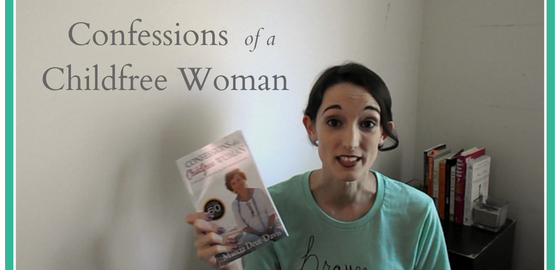
Confessions of a Childfree Woman

Confessions of a Childfree Woman

If you’re even remotely interested in the childfree lifestyle, you’ve got to read Confessions of a Childfree Woman: A life spent swimming against the mainstream. In this post, I’ll tell you:

  • Who the ‘confessor’ is
  • What the book is about
  • Why it’s important
  • Who should read it

{Psst! Because I so highly recommend this book, this post contains affiliate links. Read more about our affiliate links here.}

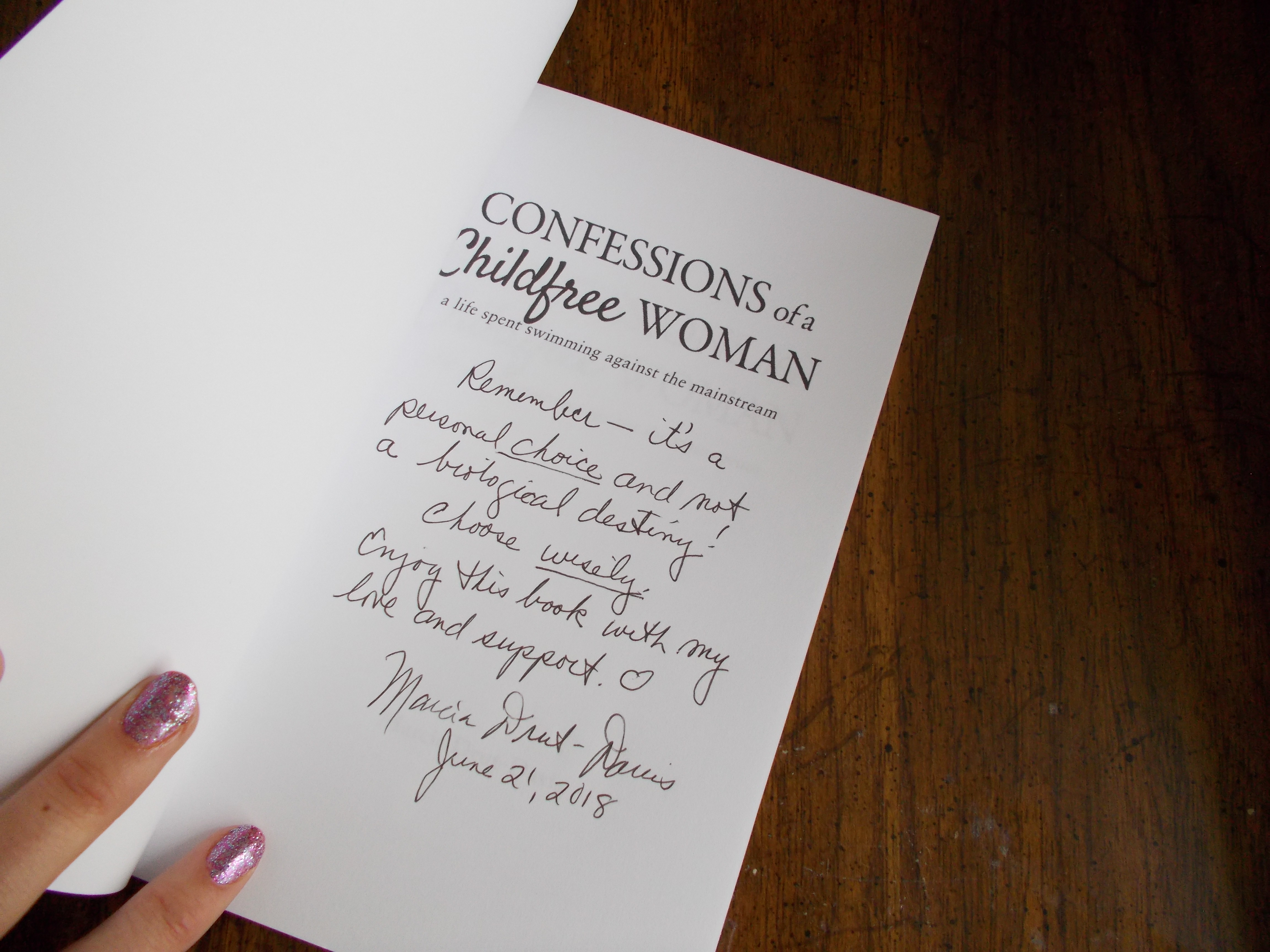
Confessions of a Childfree Woman, by Marcia Drut-Davis | The American Spinster Book Review

Keep reading to find out how you can enter to win a free, signed copy of “Confessions of a Childfree Woman.”

Who’s the Confessor?

In 1974, Marcia Drut-Davis gave an interview to 60 Minutes, discussing her choice to not have children. In spite of her calm tone and rational explanation for her choice, many viewers were outraged. She lost her job as a teacher when parents and school staff assumed (incorrectly) that a childfree woman must surely despise children.

Despite receiving death threats for her childfree stance, Drut-Davis continued to advocate for a woman’s right to choose whether or not to bear and raise children. She has been a strong and steady voice in the movement.

Want to win a free, signed copy of Confessions of a Childfree Woman? Keep reading!

What is Confessions About?

Confessions of a Childfree Woman is the deeply touching, honest, and personal story of Marcia Drut-Davis’ life as a childfree woman. She shows the reader how she came to the decision not to have children and how that decision affected her life, for better and for worse. If you’re curious about what the private lives of the childfree really look like, read Confessions.

Confessions of a Childfree Woman, by Marcia Drut-Davis | The American Spinster
Win this signed copy of “Confessions of a Childfree Woman.”
What Makes This Book Important?

Though Marcia Drut-Davis doesn’t pretend she speaks for all childfree women, her book does answer the question, “But aren’t you afraid you’ll regret being childless when you’re older?” I’ll let the book’s ending speak for itself, but Drut-Davis’ life and experiences may assuage the fears of the would-be childfree woman as well as the worried, grandchild-less parent.

Should You Read Confessions of a Childfree Woman?

If you’ve read this post this far, you’ll probably enjoy Confessions. This book is ideal for anyone who is:

  • Curious about the childfree lifestyle
  • Worried about regretting the choice to be childfree
  • Looking for a childfree role model

Want some really great news? From July 20 until July 31, you can enter to win a free, signed copy of Confessions of a Childfree Woman. Just like or comment on the Facebook post below to enter!

https://www.facebook.com/theamericanspinster/videos/1933928420238558/


Don’t want to wait? Buy your copy now: Confessions of a Childfree Woman: A Life Spent Swimming Against the Mainstream

The Baby Matrix, by Laura Carroll | The American Spinster

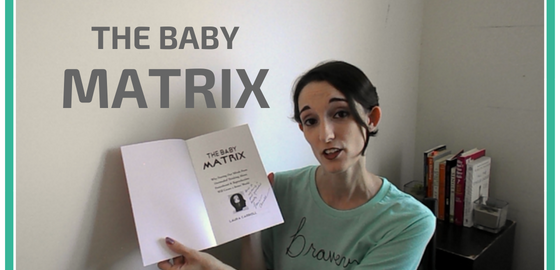
The Baby Matrix

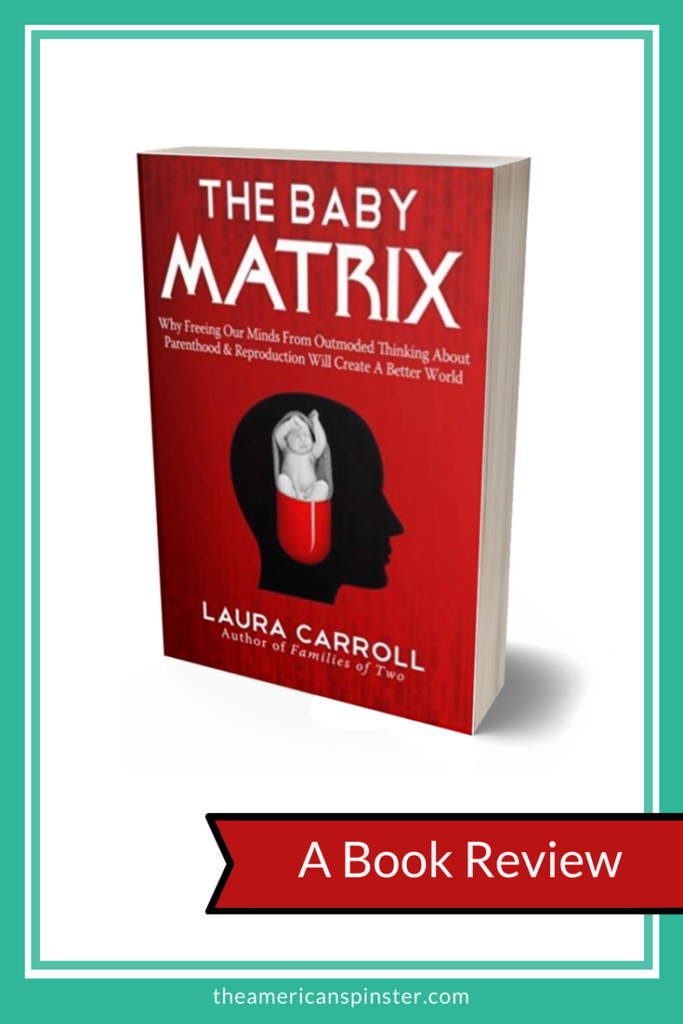
The Baby Matrix: Why Freeing Our Minds From Outmoded Thinking About Parenthood & Reproduction Will Create A Better World, by Laura Carroll, takes readers through a critical exploration of the way we look at childhood, parenthood, and procreation. Carroll explores the ideology of pronatalism through the framework of The Matrix film (hence the title).

https://www.youtube.com/watch?v=pitQLsWZd8A&feature=youtu.be

But like Neo’s awakening from the matrix, taking “the red pill” doesn’t just clear away the clouds of blind ideology. There’s work to be done. After deconstructing pronatalists beliefs, Carroll takes readers into a “post-pronatal” future. If we really were to strip away the ideas that a human’s right to have and raise children supersedes the rights, needs, and well-being of children and the world at large… what would happen?

My Reading of Laura Carroll’s The Baby Matrix

The Baby Matrix will likely cause a few knee-jerk reactions. I like to think I’m pretty progressive when it comes to beliefs about parenthood, child-bearing, and overpopulation. After all, I run a pro-childfree website and online community. But I have to admit, even I found myself shocked by some of Carroll’s arguments. Not because I actually disagreed, but because pro-natal notions are so deeply ingrained in me (and all of us).

I highly recommend reading this book if you’re:

  • Childfree
  • Concerned about overpopulation
  • Interested in children’s welfare
  • Curious about the childfree movement

The Baby Matrix is an intellectually and emotionally challenging read. Laura Carroll asks her readers to step outside of their comfort zone and ask themselves difficult—but vital—questions. It’s the kind of book that really pushes you to examine your deeply-held, and sometimes completely subconscious beliefs. Whether or  not you end up agreeing with the author, it’s well worth a read.

Where to Read The Baby Matrix

From July 20 until July 31, 2018, you can enter to win a free, signed copy of The Baby Matrix by liking or commenting on this Facebook post:

{Psst! The following is an affiliate link. Learn more about our affiliate links here.}

Since I highly recommend reading The Baby Matrix: Why Freeing Our Minds From Outmoded Thinking About Parenthood & Reproduction Will Create a Better World, it seems only reasonable I provide a way for you to get a copy right now. Just click the link below!
Your Thoughts on The Baby Matrix

Obviously, this is a pretty controversial topic. Some of the ideas discussed in Laura Carroll’s The Baby Matrix might even be a bit surprising within the childfree community. If you’ve read it, please share your thoughts respectfully in the comments below. What surprised you about the book? Which parts did you agree with? What do you hope others will learn by reading it? Let’s start a conversation about this important topic.

The Baby Matrix | A Childfree Book Review | The American Spinster