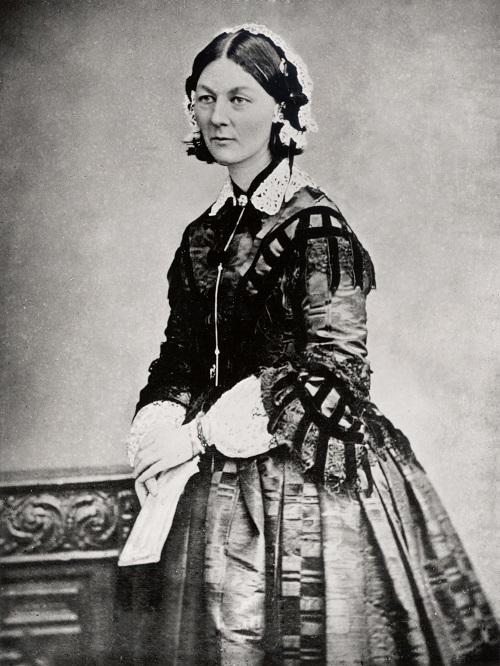
Famous for her role in the Crimean War, Florence Nightingale revolutionized how nursing was seen and practiced, especially regarding the treatment of soldiers during foreign wars. She was also a gifted mathematician, and turned her keen and logical mind toward the prevention of illness in hospitals. Many of the very common practices involving sanitation that we take for granted today gained attention through her work.
While Nightingale may sometimes falls short of the modern definition of a feminist, her ideas about women’s roles and responsibilities were very forward-thinking for the time. In fact, her contributions to the practice of medicine drastically changed Victorians’ ideas about women working in traditionally male fields. Her achievements are even more impressive when we consider that she was from a prominent aristocratic family, in which women didn’t hold jobs.
Nightingale is an inspirational, real-life spinster because she didn’t let social standards dictate her life. She had a dream and pursued it, despite the fact that it had never been done before. By daring to show her mental brilliance, she proved that women and men could be intellectual equals. And through it all she lived devoutly single life.
In short, she broke down nearly every Victorian stereotype about women, pushing us all into the modern age.
Which historic spinster are you? Take the quiz below to find out!
Fried Green Tomatoes at the Whistle Stop Cafe, by Fannie Flagg
I debated for a while about whether or not to put this book on the American Spinster review list. There are no genuine spinsters in the story, unless you count Sipsey (who had an adopted son), but ultimately I couldn’t ignore how well the book’s message applies to us.
The Story
There are two storylines running throughout the book. In present day (1985), Evelyn Couch is a woman who’s essentially going through a mid-life crisis. She feels out of place no matter where she goes or what she tries to do with her empty nest life. She missed the Women’s Lib movement (“I didn’t know you didn’t have to get married. I thought you had to,”). She’s unable to connect with her grown children, and she resents her husband, yet doesn’t want a divorce. She’s a woman who, as she puts it, has never seen her own vagina.
Depressed, lost, and inwardly angry, Evelyn encounters an elderly woman named Mrs. Threadgoode, who begins to tell Evelyn stories about her life in Whistle Stop decades ago, when the town was in its prime. Mrs. Threadgoode’s sister Idgie and Idgie’s partner Ruth are the center of her engaging, colorful stories, which make up the strategically interwoven second storyline. Evelyn begins to live for the Sundays when she gets to visit Mrs. Threadgoode – who’s become a loving, maternal friend to her – and to hear more stories from Whistle Stop.
Thanks to Mrs. Threadgoode’s friendship, down-to-earth advice, and the stories of life in Whistle Stop, Evelyn slowly but beautifully becomes her own woman.
The Themes
Fried Green Tomatoes at the Whistle Stop Cafe is, in many ways, about a woman re-creating herself. Evelyn goes through a pretty dark time, and the novel doesn’t shy away from that. Before meeting Mrs. Threadgoode, Evelyn fantasizes about her own suicide just to make it through the long, lonesome nights. Later, in her difficult and painful moments, she fantasizes about being in Mrs. Threadgoode’s Whistle Stop among the people from her stories. She imagines being a part of the community there, being loved and having – for the first time – a place of her own. By the end of the book, Evelyn confronts the fears that have controlled her throughout her life, and finally learns to be truly happy.
Why It’s A Spinsterly Read
The topics covered in this blog are topics that apply not just to those who are young and childfree, but to mature women who find themselves alone in the house after their children grow up or after a divorce. We all invent ourselves, and re-invent ourselves throughout our lives. Evelyn takes the examples of fearless Idgie, kind-hearted Mrs. Threadgoode, aspects of the silently strong Ruth Jamison, and even the contentedly unconcerned Eva Bates to help her to truly live the second part of her life. She decides who she wants to be, and with the help of her friend, becomes that person.
Fried Green Tomatoes an excellent novel for any woman, be she just starting out or at a crossroads in her life, because it paints a remarkable picture of how to stand on one’s own and, in essence, become the person she was always meant to be.
Want to receive FREE resources for living your best single, childfree life? Sign up for our mailing list today!
5 Answers to the Question “Why Don’t You Have Kids?”
If you’re over 25 and don’t have kids, you’ve probably heard this question before. And you’ll probably hear it again at regular intervals for the next 20 years. It can be difficult to answer such a personal (and often rude) question, so here are 5 excellent ways to reply.
5. I don’t like kids.
This should be a very reasonable answer. After all, why would you commit to caring for something for the next two decades if you don’t enjoy its company? And yet, this is probably the least helpful answer you can give someone. The two most common responses are, “What do you mean? How can you not like kids?” and “You’d like them if they were your own.”
That’s a big assumption to gamble 18 years and $300,000 on, but let’s move on.
4. I want to focus on my career right now.
Already a contributing member of society, thank you.
Another honest, but generally unsatisfactory answer. Despite the advancements of feminism, it’s still considered selfish by many for a woman to choose a career over a (non-existent, hypothetical) child. Despite all logic to the contrary, it’s seen as better for a woman to give up on her aspirations, conceive and birth children she didn’t want, and try to raise them without resentment than it is to continue contributing to society in a way that she already enjoys.
3. My husband/boyfriend/partner and I decided not to.
This is a tricky one, because it avoids the question directly. It’s also kind of a cheat, because it shifts some of the responsibility onto your partner. I’ve found that the people who ask this question tend to realize this, and hone in on the partner, blaming him/her for not allowing you to have kids. At this point, you can either argue that it was a mutual decision (they’ll likely go away believing that you deeply desire children anyway), or just let it go and move on with your day.
2. I can’t have children.
This is a controversial answer, assuming it isn’t true. Some people will say that, with so many women and couples struggling to conceive, using this as an excuse is callous. On the other hand, it’s the only answer I’ve found that seems to satisfy the busybodies.
And the number one answer for not wanting kids?
1. Because I don’t want kids.
It’s really as simple as that. Raising children isn’t a hobby. A child (though this may come as a surprise to many mothers) is an actual, individual human being, with its own wants, desires, and personality. Being a responsible parent means devoting the better part of the next 18 years to being a caretaker for that person.
But, ultimately…
The underlying problem with this question is that it’s not being asked by someone who’s curious about your reasoning. When someone says, “Why don’t you have kids?” they’re often really saying, “You should want kids. Now give me some explanation as to what’s wrong with you.”
Even so, when someone does ask, answer. Let them know that you don’t have kids because you take the matter very seriously, and have come to a well thought out conclusion, which is more than many parents have ever done.
Have you used any of these answers? How did they work for you? Let us know in the comment section below.
Want to read more great tips for childfree women? Sign up for The American Spinster’s mailing list:
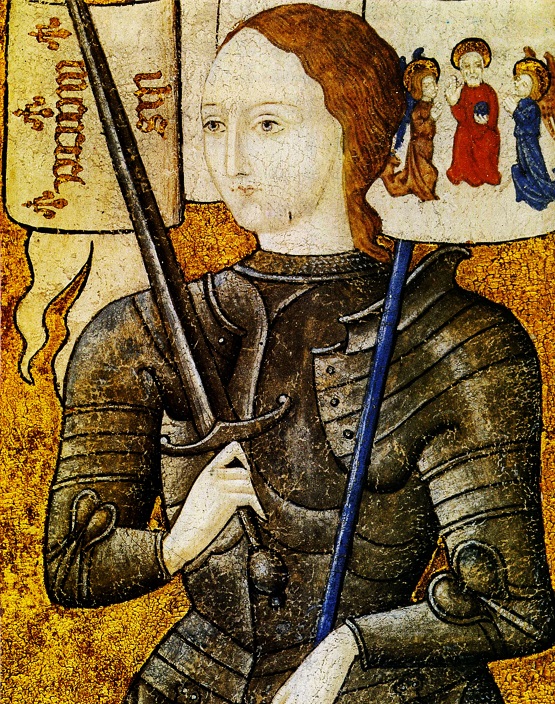
Each Sunday for the next two months, The American Spinster will be counting down our list of Top Ten Real-Life Spinsters. These brief biographies will examine the lives of extraordinary single, childfree women who left their mark on the world and made a name for themselves in history. Starting the list of is Joan of Arc.
10. Joan of Arc
Joan of Arc is famous for leading the French army against the English during the Hundred Years War, turning the tide and helping France gain the upper hand. Know also as the Maid of Orleans, the young, uneducated peasant girl claimed she experienced visions from Heaven instructing her to lead the army to victory.
Despite being untrained in any type of war strategy and having no known relatives of a higher station, she was able to convince the members of the court that she and her divine instructions were meant to lead the army. For a 17 year old girl, particularly one of no noteworthy background, to become a military leader in 15th century France was a truly unprecedented accomplishment.
Joan was eventually captured, traded to the English, and faced accusation by the church. Impressively, Joan was reported to have bested her accusers in argument during her trial, causing the remainder to be held behind closed doors. Despite her bravery and skill, Joan was ultimately burned alive as a heretic at the age of 19. She was has long been revered as a martyr and heroine of France, and in 1920 she was canonized as a saint.
Why she makes the Top 10 List
Due to her early death, it isn’t clear whether or not Joan would have remained a spinster. But whether her visions were divinely inspired or she was a strategic prodigy, she inspired centuries of ‘maiden’ women. This youthful, unmarried girl attained a very high-ranking position in a male-only field. And if she could, why can’t we all?
Want to learn more?
To learn the details about Joan of Arc, I recommend the following resources:
I’m so happy about the release of The American Spinster’s new (free) mini ebook that I decided to hold a giveaway to share it!
A Single Woman’s Guide to Creating Your Future Home Now shows you how to stop dreaming and start enjoying your living space no matter what your budget or circumstances are. Spinsters, it’s time to bring all of those ambitious Pinterest boards to life! This digital booklet is the first in a series of Spinster How-To guides, and this one is FREE when you sign up for our mailing list.
And to help you on your way toward domestic design bliss, we’re holding a giveaway of your choice of beautiful wall art from Shailey Ann Design.
These are just a few of the many options available at ShaileyAnnDesign.com.
The winner will take her pick of any 11×14 Shailey Ann Designs poster. With over 50 prints to choose from, you’re sure to see something that belongs in your dream home.
While only one entrant will win a poster, everyone will receive a FREE copy of the new digital booklet. All you need to do is sign up for The American Spinster mailing list via the widget below and you’ll be entered in the giveaway.
And if you want to improve your chances of winning, you can subscribe to Shailey Ann Design’s newsletter (worth two additional entries) or chose from other bonus entry options.
This contest will run from July 8 – July 14 (ending at 11:59pm), and is only open to U.S. and U.K. residents.
Please note that this article deals almost exclusively with the healthcare needs of biological (cis) females, and does not address the needs of trans women, trans men, or intersex people. It also does not address the differences in healthcare and medical treatment across the racial spectrum. While these are vital topics very worthy of discussion, they are excluded here simply because there is only so much I can cover in a single, one-topic, 700-word blog. I intend to address the needs of all of my spinsterly readers over time; this is simply the first of many articles on the broad topic of women’s health.
There are two major obstacles women face when obtaining healthcare. The first is accessibility, in terms of both geographic availability and affordability. The second, which I’ll be focusing on today, is a lack of knowledge about women’s healthcare needs.
What Is Women’s Health?
When you think of the term “women’s health,” you probably think of reproductive health, mammograms, and the yearly OB/GYN visit. If you have an insurance plan, it probably covers one yearly gynecological exam for women, in which pelvic exam, manual breast tumor check, and pap smear are done. If you are a middle-aged women, a mammogram every three years is generally included as well. If you have children, some portion of those expenses will be covered, and possibly even fertility treatments. And that’s pretty much the beginning, middle, and end of women’s healthcare as most people know it.
From this, a woman might get the idea that her health only differs from the standard of a man’s health in the fact that she has a uterus and breasts. She would be mistaken, but it’s no wonder we think this way. For decades the medical profession considered women’s healthcare needs to be identical to men’s, save for a few additional female-only issues (menstruation, childbirth, and – for a while – hysteria) . Thanks to a recent shift in thinking (and some 1990s legislation), we’re finally learning that the biological differences between men and women affect much more than we previously imagined. Sadly, old beliefs don’t die easy, and many women grow up believing that when it comes to medicine and healthcare what’s good for the gander is good for the goose.
Why is This Harmful?
In day-to-day life, these medical assumptions mean that women are often misdiagnosed, and that healthcare professionals often ignore female-specific symptoms of common conditions. For example, heart attacks typically manifest differently in men and women, as do a list of other conditions, including anxiety. Additionally, health education is lacking in these areas, meaning girls and women are taught only what applies to the ‘standard,’ which is men’s health. The result of this poor education (in doctors and lay people) is that women are often not receiving the same quality in care. And on top of this, they usually don’t know how to ask for the care they need.
What do women need?
Now that we’ve covered what women’s health is not, what do we as women need from our healthcare?
The short answer is that we need healthcare providers and health plans that considers how our physical and mental well-being are affected by our biological makeup, including our sex. And we can obtain that by:
becoming educated
Pick up a subscription to a women’s health magazine. Buy a book dedicated to women’s whole health (including – but not exclusively – reproductive health). Learn about all of the things you weren’t told in your high school health and biology classes.
finding a good woman’s health doctor
Your knowledge will only take you so far by yourself. You also need to find is a doctor that listens to you, takes your biology and life situation into account, and believes you – regardless of their gender.
taking a firm stance when it comes to your health
Several studies and editorials have shown that women’s pain is seen as less severe than men’s, So rather than allowing a doctor’s dismissal to make you second guess yourself, it’s up to you to stand up for yourself. If you can, seek out a doctor who takes your observations seriously. But if switching doctors isn’t a possibility, it is imperative that you become your own advocate.
Don’t wait until sickness strikes at 11pm on a weekend to make these changes. Do it right now. If you’re an adult, no one can be more responsible for your health than you yourself. Don’t depend on a medical system that’s woefully behind the times. Be your own advocate starting this very moment.
The next articles will look into how to find a good doctor or women’s healthcare center, whatever your income level or state of insurance/non-insurance may be, as well as how to support women’s health.
If you’d like to receive more helpful resources for your single & childfree life, join the American Spinster mailing list:
This is a question that keeps coming up time and time again as we continue to wade through the waters of women’s health. Now the obvious answer is “Yes, someone can believe in whatever ideas they want to, regardless of how well they line up or how severely they contradict one another.” But the underlying question is whether or not it’s ethical to seek to end legal abortion while simultaneously trying to prevent access to contraception.
Definitions
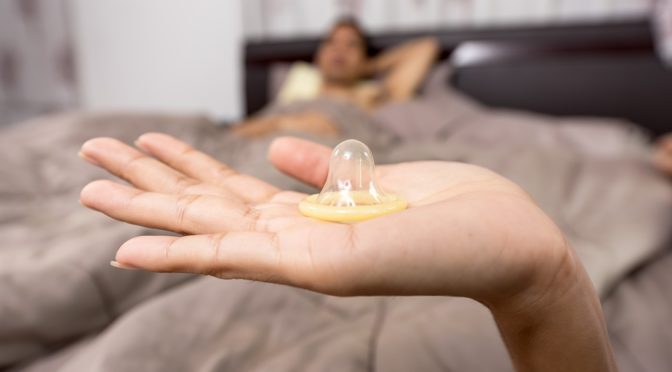
A contraceptive is a device (such as an IUD or the birth control pill) used to prevent conception. Note that conception is the fertilization of an egg and occurs before pregnancy.
The Issue
The basis for this issue stems from religious doctrine and its interpretation. A large number of Christians are opposed to abortions because they believe that the human fetus (sometimes even a fertilized human egg) must be seen with the same rights and personhood as a post-birth child. The Catholic church also formally denounces abortion for the same reason. Additionally, the Catholic church is – perhaps famously – against the use of contraceptives among its members, as it believes sex and reproduction should never be uncoupled. Many other protestant churches and church groups are also against the free or low-cost distribution of contraceptives, believing that it will encourage non-married people to have extra-marital sex, which is accepted as a sin throughout Christianity and other religions.
Things start to get muddy, however, when one considers that the same freedom of religion that allows these and all other groups to practice their religions and engage in or abstain from whatever practices they choose also allows others to do the same. Under U.S. civil law, it is legal to use contraception and to engage in consensual sex with any consenting adult. It should also be noted that abortion is also legal in all 50 United States.
Some sobering facts:
50% of pregnancies in the United States are unplanned.
Many pro-life politicians and other advocates strongly believe that illegalizing abortion is the best way to prevent it, despite undeniable evidence that – throughout world history as well as in the relatively recent history of this country – abortions will continue whether it is legal or not. Illegal abortions will simply be far more dangerous to the woman.
This brings many who are both pro-life and anti-contraception to a difficult place. If the overwhelming number of abortions occur from unwanted pregnancies, finding a way to reduce or eliminate the occurrence of unwanted pregnancies would be a sure way to reduce the number of abortions. The good news is that there is a way. And unlike banning abortions, this solution has never yet been tried on a large scale, so there’s significant hope that it might actually work.
The solution is making contraceptives easily accessible to everyone. Those who have religious conflicts of interest will find that they must decide which they, their religion, and their God finds worse: murder (as many pro-life people believe abortion to be) or allowing others to have sex in ways that they themselves are not permitted. You’d think the answer would be obvious, and yet for decades religious groups have actively fought against the disbursement of free, low-cost, and sometimes even full-cost contraceptives.
It’s time to stock the shelves with affordable, easily-available birth control.
So can you be pro-life and anti-contraception? Certainly, but not without engaging in outright hypocrisy, and not without actively creating a need for the very procedure you’re so opposed to.
No, for the very last time, you are not paying me to have sex.
Most of you probably remember several years ago when Rush Limbaugh declared that Sandra Fluke was a ‘slut’ who wanted taxpayers to pay her to have sex. Fluke was making the case for contraceptives to be covered by healthcare, which would seem like a no-brainer when one considers the enormous cost of raising a child, which can be subsidized by taxpayers through programs like WIC, Medicaid, and other welfare programs for children of low-income families. But the obvious cost-savings of subsidizing contraceptives over children isn’t the point of this article. The point is that the idea – which somehow persists – that women receiving low-cost or free contraceptives are being paid to have sex goes so far past a logical fallacy that it’s about to come back around the other side and pass it by again.
But if you’ve got some friends, co-workers, or family members who like to talk about how responsible XX chromosome owners are using their tax dollars to fund their sinful escapades, simply reply with one of these 4, easily-digestible points.
1. If women on birth control are prostitutes, so are mothers receiving government aid.
Every mother has had sex (though not always consensually). So how is it that a woman who takes contraceptives to prevent pregnancy is being paid for sex, while a mother on government assistance isn’t?
2. Women on birth control aren’t always having sex.
Anyone who’s pregnant must have had sex, but due to the nature of hormone based contraceptives and devices such as IUDs, women use contraceptives whether they’re having sex or not. Some women use birth control for reasons completely unrelated to sex.
3. No one is being paid.
I’ll repeat that: no one is being paid. Being able to obtain low-cost or free birth control is not the same as being paid. If you think it is, trying paying Mr. Limbaugh with pill packs and see if he accepts them as currency.
4. Even if they were being paid, it wouldn’t be for having sex.
I want to stress this: the women using contraceptives aren’t being paid (though the pharmaceutical companies providing them are… does that make them sluts?). However, even if we were to imagine that receiving subsidized contraceptives was somehow the equivalent of receiving money, women would be receiving that money to either a) not get pregnant if/when they have sex anyway or b) treat a hormonal imbalance or other disease or disorder.
So next time your outspoken uncle tries to talk about how women are making a living off of subsidized birth control, you can kindly let him know why he’s been misinformed.
If you’d like to receive more helpful resources for your single & childfree life, join the American Spinster mailing list:
Two studies have come to light in the past year that have made a splash in women’s health. And the controversy they’ve generated has opened a door into the hushed history of birth control…
The Studies
1. What Women Have Been Saying All Along
The first resulted in data that simply showed that depression was higher in women and teen girls taking oral contraceptives than the general population, and suggested a causal link. This caused a stir because oral contraceptives have been having this effect on women since literally the very first trials on the pill, yet was not confirmed by scientists until over 50 years later. Even more upsetting is that no new technology or novel approach was used to draw this conclusion; all of the evidence has been there all along.
Understandably, this can feel both vindicating and upsetting to women who have suffered these side effects. Often doctors neglect to inform patients of potential side effects such as these, and even when it becomes clear the medication is having an adverse effect, many times pharmacists and other healthcare professionals either deny that they exist or insist that they’ll go away. The fortunate patients are able to switch to a different type of pill or find another form of contraception that meets their needs. The rest simply endure, either believing it’s all in their heads, or accepting that the side effects are preferable to an unwanted pregnancy.
Now, at last the medical community acknowledges what many women have know for decades. Yet who wouldn’t feel some resentment that it too so long to finally study and admit it?
2. When Men Are Take More Seriously
On the heels of this study comes information from a clinical trial of a birth control injection for men. It should come as no surprise to doctors, researchers, or women who have taken the pill, but many men in the test group experienced the typical side effects, including changes in mood and loss of libido. What did come as a shock to some was the fact that 20 (of a group of 320) participants stated that these side effects were unbearable, concerns for the participants’ safety were raised, and the trial was halted.
Now, if a number of participants refuse to continue, it’s not uncommon for a clinical trial to be suspended. Nor is it a bad thing that researchers took these side effects seriously enough to stop the trial to ensure the safety of the subjects. However, what’s leading to outrage in some is the fact that it appears that when men experience exact same things women have been complaining about for 50 years, researchers may be either indefinitely suspending research and production or possibly even going back to the drawing board.
Let’s be clear – no one, male or female – should have to suffer through these side effects, particularly if they can be avoided. Most women feeling upset about this development aren’t calling for men to suffer. The problem is that this is yet another (and disturbingly modern) example of women’s health being ignored or dismissed while men’s health is not.
The History
All of this gets even more damning when we examine the somewhat sordid history of the development of the pill. In addition to some wildly unethical treatment of (unknowing) test subjects, we’ll find that at the outset an injection or pill contraceptive was considered for men. However, the idea was scrapped due – in part – to the assumption that men wouldn’t tolerate the side effects. The female birth control pill continued under the (correct) assumption that women (who have always been legally and socially held responsible for the children that often result from sex) would accept them. Essentially, if it gave women control over their own reproduction, they would tolerate the side effects. Men, presumably, would not.
We should take note that the original birth control pill, Enovid, contained up to ten times the amount of hormones needed to prevent ovulation, leading to more frequent and more severe side effects. Since then, the pill has been greatly improved by cutting down the dosage. Even so, as our first study shows, many women still experience side effects that can dramatically reduce their quality of life.
The Fallout
So, why are women angry about all this? Because many of us feel that this is just one more example of a problem not being considered a problem until it’s something men have to deal with. This is the result of a patriarchal (note, not “male-dominated” but “patriarchal”) medical establishment within a patriarchal society that dismisses the suffering of women but actively addresses the suffering of men.
The Future
What does this mean for the future of birth control? There are three possible outcomes of the suspension of the clinical trial for men’s contraceptive injections.
The first is that the trial will resume and men will be told that they must deal with these symptoms and potential dangers just as women have (I don’t think that’s very likely).
The second is that the trial will never be renewed and this method of contraception will be abandoned. This will clearly lead to anger and resentment as women will still be faced with the often physically unpleasant task of being responsible for contraception.
And the third and possibly most inflammatory outcome is that the drug may be re-designed to minimize the side effects in the male injection. Imagine how women who have endured depression and the loss of sex drive for years will feel if it turns out there was a fix for this all along, but no one looked into until men began to suffer as well.
If you’d like to receive more helpful resources for women, join the American Spinster mailing list:
” alt=”Top 10 Things Every Single Woman Should Do” width=”735″ height=”1102″ />
How to have a meaningful life without kids – Part 5/5 – Keep Your Focus on the Endgame.
Or, Don’t get too sidetracked by the mini-quests.
Do you ever play a video game, and get so wrapped up in a side quest that you lose sight of your main goal? You hunt around for a magical object that will open the gate to the new location, then gather information from the NPCs to track down the weapon, which you can then take back to the new location and finally defeat the latest boss, completing your side quest.
Obviously in a game, as soon as you finally finish all that, you can get back to the main goal. But in real life, some people either completely forget about the main quest, or they never knew about it in the first place. So when they finally finish the mini-quest, they’re left with… nothing. Just some useless sword that doesn’t seem to be good for anything.
Well, I finished the quest. Now what?
The Problem with Mini-Quests
This is the disillusionment that falls over people who were focused on real life’s mini-quests. The mothers who had children because they thought it would make them happy; the success-driven business men and women who believed that once there was enough money they could relax; and the single, childfree people who pursued pure, momentary gratification believing that self-indulgence was the goal in life.
Dissatisfaction and disappointment don’t come from choosing a certain career or lifestyle. They come from putting one’s faith and hope for happiness in something outside of oneself. For example…
Building Wealth
The problem with making financial security your life’s goal isn’t that money is bad. It’s that money is just a means to an end. When you focus on the means and lose sight of the end, your goals will shift. Because of that, when you finally do attain those new goals, you won’t be where you planned. Even Jen Sincero, money-loving author of You Are A Badass at Making Money: Master the Mindset of Wealth stresses that the manifestation of money in your life is a direct result of your badassery. She states that creating the truest, most successful version of yourself is the goal, and money is the means to that end.
“Where did all our passion go, Mr. Bank?”
Raising Children
The problem with making children your goal is that children are actual people. They are their own individual selves, not tools for your comfort. Being a parent and watching your children grow can be an immense source of comfort, but if your goal in life is to ‘be a mom,’ you’ll either be disillusioned by the reality of parenthood, or you’ll be disappointed when your kids grow up.
Being the Ideal Partner
If you’re in a relationship, of course you should try to be the best partner that you can be. But not at the exclusion of all else. How many times have you seen a woman who devoted herself to her man, raising his children, managing his life, etc., but at the end of 20+ years she was dumped and on her own? No employable skills, no knowledge of how to make her own way.
The lesson from this isn’t “never trust a man,” it’s “never cheat yourself.” As with the previous two examples, the problem arises when the focus of your life is something outside of yourself.
TL;DR:
Gaining money, raising kids, and being the ideal partner are noble secondary goals (cool side quests). But none of them should be your all-time goal (they’re not what’s going to win the game).
So What Should My Main Quest Be?
To lead a meaningful life, your underlying focus and goal in all things must be to improve yourself. And when I say “improve,” that’s not to imply that you’re in a bad place. It just means you’re in your starting place at the beginning of the game. Think of every new thing you learn or accomplish as leveling up. The classes you take, volunteer work you do, and so forth are all power ups you pick up along the way.
Do you want to have children? Good. Enjoy those experience points. Do you want to travel the world? Go ahead. You’ll find plenty of ways to increase your awareness and add to your supply of knowledge. Want to amass wealth? Awesome, fill your inventory with items that will make your journey more comfortable. Whatever you do, remember that you are the main character in the story of your life.
But Isn’t That… Wrong?
We’re taught to believe that focusing on ourselves is bad, selfish, or downright hedonistic, but it’s not. When you’ve got the controller, your avatar is the only one you can control, so your well-being must be your focus. What’s selfish is dragging other people into your life and then sacrificing their well-being for yours (and that includes having kids you don’t really want).
So go out, travel, make money, indulge, and have fun. But don’t let these things become your goals or sources of happiness, or you’ll likely find yourself alone at the end of it all.
And remember…
When one mini-quest is complete, move on to the next one. Don’t look back and tell yourself, “If I’d only made a different choice back at the last castle, I’d be happy!” The game isn’t over – you’ve just decided to stop in the middle and mourn a decision that, ultimately, wouldn’t affect the outcome in any significant way. If you get to 45 or 50 and think that you’d be happier if you’d had children, you’re wrong. Pinning your hope on someone else is never the answer. If you’d had kids, you’d just be unhappy in a different way.
Simply enjoy that fact that you are your goal; you are your quest. Because in the end, the only person you’ll really have, right up until your last breath, is your own amazing self.
Read the rest of the Meaningful Life series here:
Want to receive more resources for living a happily single and childfree life? Sign up for the American Spinster email list:























 ” alt=”Top 10 Things Every Single Woman Should Do” width=”735″ height=”1102″ />