The you’re in the right place! Just click here to enter to win a FREE full-sized Singles Swag subscription box. For more information, watch the video below:
https://youtu.be/9wu1XHVvLwY
Ready to enter? All you need to do is give us an email address where we can contact you if you’re the lucky winner. Let me know in the comments what your favorite item is in the box.
This free raffle runs from Monday, June 25, 2018 until Saturday, June 30, 2018 at 11:59 p. m., Eastern time. One winner will be chosen at random and notified via the email addressed used to enter the giveaway. Neither the winner’s name nor any other identifying information will be shared.
Entering the Giveaway and Eligibility
To enter the giveaway, entrants must provide a valid email address to the form located at this address: https://mailchi.mp/5530cccbf5ad/american-spinster-june-giveaway. Any entrant may unsubscribe from this list at any time. However, if an entrant unsubscribes from the list before July 2nd, The American Spinster will be unable to contact them should they win. Unsubscribing before July 2nd will therefore effectively mean withdrawing your entry.
Winning and Receiving the Prize
Once contacted, the winner will need to provide a valid shipping address so that The American Spinster can ship the prize. Should the first winner fail to provide a shipping address within 7 days of being notified, a runner-up winner will be chosen.
The Prize
The prize is a full-size Singles Swag subscription box for June 2018. See the video above for a list of items included in the box. The American Spinster is unaffiliated with Singles Swag, and this giveaway is not sponsored or endorsed by Singles Swag.
Single? Sign Up for a FREE Email Course
If you don’t quite love your solo life yet, sign up for the American Spinster’s FREE email course. It won’t affect your odds in the raffle, but it could give you a whole new outlook on your single life.
I live in a pro-birth family. Like many Boomers, my parents grew up with a lot of siblings. As a result, I grew up with a lot of cousins. There are seven of us in total (all of us now in or approaching our 30s). Of these seven, six of us are either childless or childfree.
This is becoming more common¹. Family trees that once had 5+ children every generation are suddenly seeing just a few new shoots. And for the older generation, that’s hard to understand. Grandparents, parents, aunts and uncles seem continually puzzled by the lack of baby-making from the younger generation.
Their response can be to pressure we young adults to have kids. And for the childfree, that can feel uncomfortable. This pressure is even greater when the so-called ‘responsibility’ of having children falls to just one person. At least in my case, I have five other cousins who are equally accountable for the lack of offspring. For childfree people from a small pro-birth family, all focus falls on them.
How to cope with being childfree in a pro-birth family
As I mentioned in How to Tell Your Parents You’re Childfree, it’s important to figure out why your pro-birth parents (or other relatives) want you to have children. Some of the common reasons I’ve found are:
They have a vague feeling that being childfree is wrong.
They think you aren’t having children because you don’t like your family.
They’re afraid the family is going to be forgotten (think Disney-Pixar’s Coco).
They want to see, hear, and play with babies.
They believe it’s the only way you’ll be happy (and they really, truly want you to be happy).
Once you understand the reasons for their insistence, sadness, or confusion over your choice to be childfree, you can help them understand.
My advice for family gatherings isn’t to start a discussion about being childfree. That can get uncomfortable quickly, and it’s less likely to be effective than just slipping in some ideas here and there.
How to respond when they question you
When the dreaded topic of “When are you having kids,” or “Why don’t you have kids” does come up, remember that they’re not really asking that question. Your pro-birth family members are telling you that they’re uneasy with your childfree status.
Just remember, that’s okay. Yes, it’s kind of rude of them to ask, but while the question may be inappropriate, their feelings aren’t. It’s perfectly natural for them to wonder—and worry about—what’s going to happen to the family line.
Most of us grow up wanting to make our parents and relatives happy. When we get older, it can be tough to reconcile their wants with our individual autonomy. We want to please them, but we also know that it’s our choice to have or not have children. So what do you say?
Bearing in mind that they ask because they worry, not because they’re just rude for the sake of being rude, just smile and say, “Don’t worry, Aunt Judy, it’ll all be fine.” If they aren’t ready to hear more, there’s nothing else you can say.
And if they really want to know…
Sometimes relatives are genuinely interested in your reasons for not having kids. When that happens, have the talk with them:
The worst case scenario is that they aren’t ready to hear it, and they remain puzzled and worried. But if they’re interested and open-minded, you’ll set their mind at ease regarding your choice to stay childfree.
Have you been in this situation? How did you deal with it? Share your experience with the childfree community in the comments below.
It’s easy for single or childfree women to feel weird about loving their careers. In this blog you’ll learn:
Why we feel uncomfortable loving our jobs
Why you should love your work
3 ways to totally rock your career
No matter what job you have, what industry you’re in, or what type of job you’re stuck in at the moment, these 3 tips will help you create a badass career. So let’s get to it.
Why Childfree / Single Women Feel Weird About Their Careers
Why do we have such a weird relationship with our work? I think it’s because, in the grand scheme of things, women haven’t been holding ‘traditional’ jobs for very long. Remember that before WWI, even poor women generally became full-time caregivers after marriage. The woman who continued working through her thirties was typically a spinster.
After the sexual revolution of the 1960s, married women began holding regular jobs outside the home. Society reacted to this dramatic shift with confusion and a new set of rules, including:
Married women can work when it doesn’t interfere with child-rearing.
These jobs must provide supplementary – not equal – income for the family.
Women can’t care more about their jobs than they do about their husbands or children.
So a married women could love her job as a nice little side hobby. Something to occupy her when her kids and husband don’t need tending. But what about unmarried and childfree women? Sadly even women’s lib couldn’t get rid of that social stigma. The childless, single woman was still a piteous thing (or would be once her sex appeal faded), and any zeal she felt toward her job was just a sad substitute for a family.
The reason we childfree, single women feel so dang weird about loving our jobs is because ever since we started working, we’ve been told that if we love our work too much, we must be lacking or neglecting something more important. We still see this everywhere. On TV, in the movies, and in the books we read. Happiness for women comes from their family, and loving a job too much threatens to undermine that need.
Why You Should Take Care of Your Career
If we ignore the notion that a ‘career woman’ is someone who has to turn to her job for fulfillment because the rest of her life is lacking, we see that focusing on your career is actually really important. Not only does it get you the money you need to live your best life, but you’re committing 40 of your waking hours to it every week. That’s over one third of your waking hours every week. That’s a ton of time to spend on something you don’t really care about.
Your career isn’t just something you should care about in a theoretical kind of way. This is something you should actively care for. Take time to make it something that you’re enjoying and that’s contributing to your life in a really significant way. Trying to pretend it doesn’t matter because you’re afraid of looking like the loveless career woman is a bit silly. So let’s set that aside and fall madly in love with our careers, shall we?
3 Ways to Rock Your Career
Okay. So what are the three big ways you can take care your career and make it totally rock? {Psst… read through to the end for an awesome FREE resource for loving your solo life!}
1. Make time for career development.
Rarely do companies offer career growth training to their employees anymore, so it’s up to you. Set aside an amount of time every week (ideally measured out through each day) when you can work on a skill that will help you move through your career.
This helps you by:
Displaying your dedication to your role
Getting the skills you need to advance
Keeping you motivated for your future
What is a skill you need to help you on your ideal career path? Find the resources you need and start using them.
2. Be a student at work.
This applies whether you like your current job or not. No matter how far it is from your dream job, there is something valuable you can learn there that will help in that future job Always go to work with the mindset of someone who wants to learn how to do their job better. Find the areas where you can improve and focus on them. Make weekly goals of one small thing you want to improve.
This will help you:
Get better at what you do
Show management that you’re willing to learn
Keep your ego out of your way
Keep a list of the things you learn through your job each week.
3. Be nice.
It’s obvious, but it took me years to really understand what this meant. I grew up believing that only certain people deserved my friendship or good behavior. When I did, I always felt like the outsider. Like this job (whichever one it was) wouldn’t last too long because only a few people really wanted me there or understood what an asset I was.
That didn’t work out too well, so I tried something different. And now I’m encouraging you to see everyone (yes, even that person) as a friend. You’re in a relationship with every one of your co-workers and bosses. Give each one of those relationships the attention it deserves. When I started seeing my co-workers as relationships I needed to work on, things got so much better.
This benefits you for three main reasons:
You won’t have enemies at work.
You won’t be drawn into low-vibrational gossip or backstabbing.
Bosses recognize people that play well with others as an asset.
You deserve to be friendly and kind to everyone you work with. It’s difficult, but I promise it’s worth all the extra effort.
Are You Ready to Love Your Solo Career?
There’s nothing wrong with loving your work and feeling fulfilled by it. The fact that you’re a woman (and a woman ‘without a family’) doesn’t change the fact that the work you give this world is valuable and meaningful. Love your career. Love the work you do. And most importantly, love your amazing, solo self.
If you’d like an in-depth, FREE resource to help you truly love your solo life, sign up for the American Spinster’s 30-Day Email Challenge. You’ll get a new challenge delivered to your inbox every day for 30 days. Take the plunge and sign up now!
Has your solo status made you feel uncomfortable being a ‘career woman?’ Let me know in the comments below!
Even the most contentedly introverted among us feels lonely at times. As a solo woman—someone who sees herself as happily single—it’s easy to feel like loneliness is a symptom of defeat, failure to love your single life. But there’s nothing wrong with being lonely and single. Loneliness is a normal, human emotion, even for the happiest solo woman.
Unless your feelings of loneliness are persistent and affecting your daily life, they’re probably not cause to doubt your lifestyle. Just as feeling occasionally angry or sad wouldn’t make you second-guess your career. Here’s how to deal with being lonely and single as a solo woman.
1. Acknowledge and accept the feeling.
Remember that it’s perfectly okay to feel lonesome sometimes. We live in a world that sees feeling lonely as a sign that something is deeply wrong and needs to be righted immediately (this is especially true if you’re lonely and single). Worse, the media we consume usually says that we can get rid of those frightening lonely feelings by finding a partner. Both of these beliefs are wrong. It’s okay to be lonely, and having a loving partner won’t keep you from feeling lonely in the future.
Loneliness simply signifies a need, just like hunger. And you wouldn’t expect to never feel hunger just because you bought a fridge.
2. Figure out why you’re lonely.
What’s causing you to feel lonely? For myself, loneliness normally comes from one of two sources. Either I really want to communicate with someone and have no one around, or I’ve tried to communicate with someone and they either didn’t listen or didn’t understand. In either of these situations, my oasis of solitude can like a prison room at the top of a tower.
It may be entirely different for you. Take a few moments to look within and find out why you’re feeling lonely. Then acknowledge that reason. For me, this goes like, “I tried to explain my feelings to my best friend, and she didn’t understand. Now I look around my home and it feels empty and lacking.”
3. Believe that your feelings are okay.
Remember, feeling lonely while single doesn’t mean you’re not a strong, solo woman. It just means you need social interaction like every other healthy human being. Our parents, society, and popular culture have trained us to believe that the first flutterings of loneliness are heralds to the loneliness apocalypse (loneli-pocalypse?), and we’d better change our ways lest we end up forever alone.
You wouldn’t believe you had a digestive problem every time you felt hunger, would you? Of course not. Because we understand that hunger signifies a normal need, not an unfulfilled life. In the same way, occasionally feeling lonely means you need some social interaction, not a total lifestyle overhaul.
4. Either let the feeling pass, or adjust your thinking.
Sometimes, you just need to let yourself feel lonely. If you’re in a situation where talking to someone at that moment isn’t an option, or if you’re feeling sad from being ignored or misunderstood, it’s okay to feel lonely. Remind yourself that this feeling is fine, and that it will pass.
You can also examine your situation from a more helpful point of view. In my case, I’d say to myself, “Having one poor conversation doesn’t mean that things are hopeless and that my life is lacking.” Getting rid of that feeling that the loneli-pocalypse is upon me usually makes everything seem better.
5. Do something.
You don’t want your response to the first few pangs of loneliness to be to run out into the world and search for someone to get rid of this feeling. Being lonely and single is fine, and it’s vital to accept that. Trust me, it’ll save you from some panicked (and therefore bad) decisions. To compare loneliness to hunger again, when you felt your stomach rumble, you wouldn’t drop whatever you’re doing and shove the first piece of food you found into your mouth just to avoid feeling hungry for a few moments, would you? Of course not. You know that hunger doesn’t mean something’s wrong, and most of us can sit with hunger for a few minutes without fearing that we’ll starve to death. Loneliness is the same way.
Having said that, once you’ve accepted your feelings, do something about them. As I said earlier, loneliness signifies a need for social interaction. If you’re in a situation where you can call a friend or go out for coffee, go ahead. If not, find some other way to meet that need.
When I’m feeling lonely due to feeling ignored or misunderstood, I’ve found it very helpful to write. Not only is this productive (making me feel accomplished), it helps to alleviate the source of my loneliness. When I write a blog and post it, my readers read it. Someone’s hearing me after all. What I write doesn’t even have to be related to what I wanted to express to that other person. Sometimes I just want to feel heard.
Just remember that being lonely and single doesn’t mean something is wrong or that the solo lifestyle isn’t for you. Don’t over-think yourself into a panic. It’s okay to feel lonely now and then.
When is being lonely and single a sign of something more serious?
Of course, the solo lifestyle isn’t for everyone. How do you know if it’s for you? Just remember that the “cure” for loneliness isn’t a partner. If you’re feeling lonely more often than you think you should, it’s probably best to work on your own social interactions with others instead of pretending that binding another person to you will fix things.
Seek out a partner if you believe being in a relationship would help you live your best life, not because you’re afraid of feeling lonely.
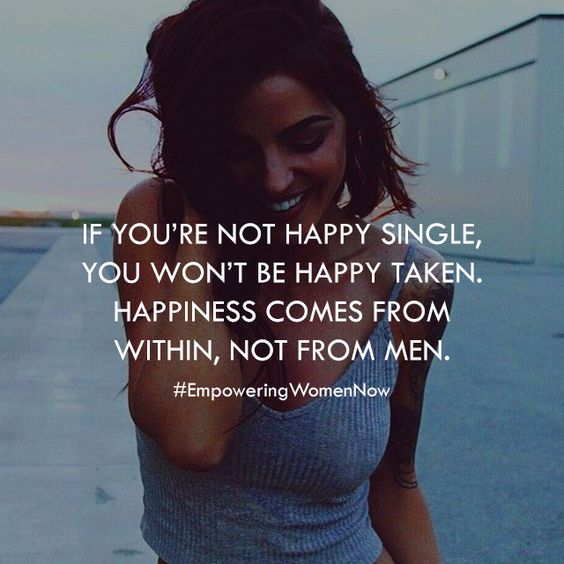
instagram.com/empoweringwomennow/
What do you think? Is it perfectly normal for people to feel lonely, no matter how happy their lives are? Let me know in the comments below.
If you’d like to receive more helpful resources for your single & childfree life, join the American Spinster mailing list:
In Part I (How we Devalue Motherhood in a Pro-Birth Society) I went over the ways we depreciate motherhood, despite living in a world that idolizes babies. In Part II, I’m going to talk about how we can create a culture that genuinely values mothering by making motherhood a choice.
There are, of course, direct actions we can take to improve the treatment and lives of mothers. For instance, we need to provide actual maternity leave. We need to pay living wages to everyone so that mothers and family units don’t need to choose between raising their children and working two jobs to make ends meet. These and other steps like them are important, but nothing will ever truly be resolved until we begin to change the way our society treats motherhood. And here’s how to do that.
Realize the motherhood is not a woman’s default role
In order to value motherhood, we have to stop treating it like the default.
We’re aware of how important the work of mothering is, because for most of us it was our mothers that kept us alive through childhood. But because producing and caring for babies is what women do, we don’t feel the need to truly value it.
Likewise, we understand how important having a fully staffed McDonald’s is, because it’s this institution that provides us with the fast and cheap meals that get us through the day. But because we believe there will always be a class of people ready to fill the roles there, we don’t value fast food workers.
Mothers are a given. They’re necessary for the structure of our society to remain unchanged, but they’re not going anywhere. Because we believe women will always become mothers, we feel no need to place any real value on motherhood.
This is what’s got to change. When this changes, our society will begin to take things like real maternity leave seriously. And I believe one of the ways to accomplish this cultural change is to start seeing motherhood as a choice. We need to treat it like a valid life decision, but a choice nonetheless.
How do we treat motherhood as a choice?
To treat motherhood like any other lifestyle choice, we need to stop assuming baby girls will inevitably grow up to become mothers. If a girl approaching adulthood expresses a desire to be a mother, let’s treat that choice with the same level of seriousness as entering a convent. Let’s ask, “Are you sure you want to commit to this for the rest of your life? Have you thought it through? Do you know what your day to day life will be like?” And if she is certain, let’s fully support her.
Fully supporting women who have made the conscious and careful decision to become mothers means we have got to stop—this instant—acting like the overworked, over-stressed, perpetually exhausted mother I mentioned in Part I is the Good Mother.
So, how do we start a huge, cultural shift?
Start by being aware. When you see media portraying good mothers as being over-tired and not receiving support at home or work, be cognoscente of it. The more you notice it, the more you’ll realize how pervasive it is. When you find yourself assuming that your female friends or co-workers will one day become mothers, stop. When someone gets married, don’t ask “when” they’re having kids. Start by simply talking about motherhood as one option available to women.
And if that sounds anti-climatic (just changing a few things in your daily conversations?) think about what an impact those small changes could have on the people you’re talking with. My grandmother told me when she was a young woman in the 60s, already with children of her own, one of her co-workers said that she and her husband decided not to have children. And that was the first time my grandmother had ever heard anyone say that. She had never heard anyone talk about having children as though it were a choice.
Today we have words like “childfree,” but although people have heard of the concept, it’s still foreign and mysterious. Talking about it, even in passing, helps make it a normal possibility. It helps women realize that they have that choice.
Is motherhood a choice for everyone?
While we’re talking about motherhood as a choice, we’ve got to address the uncomfortable fact that for many women, no such choice exists. Even in the United States, many women still don’t have reasonable access to contraceptives or any type of reproductive education. The horrifying truth is that for many American women, motherhood is still not a choice they get to make for themselves. It’s more or less forced upon them due to state-sponsored reproductive ignorance, lack of reproductive healthcare and accessible contraceptives, and restrictive abortion laws.
It’s easy for childfree women, who generally have access to contraceptives, to forget that many of our sisters are not so fortunate. And yet, despite continuous attempts to de-fund Planned Parenthood (one of the few institutions working to prevent unwanted pregnancies in the first place), contraceptive use is still on the rise. Let’s all do what we can to help that upward trajectory continue. When you vote or donate your time or money, remember to do so in a way that helps make motherhood a choice for all women.
How we talk about mothers in the childfree community matters
Finally, we in the childfree community should start being conscious of how we talk about mothers. I’m deeply against the common practice of childfree women referring to mothers as stupid, shallow, selfish human beings. Let’s stop using terms like “breeders” and acting like we just can’t imagine how anyone could be idiotic enough to willingly have a child. Wouldn’t our time and energy be more effectively used to spread the positive message that motherhood is a choice? Shouldn’t we focus on making sure women are able to choose the childfree life if that’s what they’d prefer?
I have nothing but respect and admiration for the mothers who consciously choose to have children and strive to raise them in loving and supportive homes. And if you believe your childfree life is better than a mother’s life, aren’t you pretty mean-spirited for berating someone you see as less fortunate? Let’s praise good mothers, support mothers who need support, and make sure that in the future, no one takes on the mantle of motherhood unless she truly wants it.
That’s how we can value motherhood and make the world better for everyone.
If you’d like to receive more helpful resources for your single & childfree life, join the American Spinster mailing list:
What does a happily childfree woman have to say about motherhood? First let me say that I’m honestly not against motherhood. I’ve met women who are good mothers, and I would love to see more good mothers like them. My goal in creating The American Spinster has always been to encourage a critical examination of our cultural norms, and to encourage women to take the occupation of “mother” very seriously.
If you’ve read anything else on this site, you’ll know I think something is deeply wrong with our present society in that we make motherhood the default state of being for an adult woman. But this isn’t because I think parenting is inferior work. As I’ve said before, parenting is a vocation. Only those who are truly called it the work of raising children should become parents.
The devaluing of motherhood and does a disservice to mothers, women, and our society.
How do we devalue motherhood in a pro-birth society?
Seeing the following commercial is what spurred me to write this blog.
https://www.youtube.com/watch?v=HB3xM93rXbY
The reactions to the revelation that this god-awful job was motherhood honestly appalled me. Whereas I initially thought, “Oh wow, what a deep commentary on how horribly mothers are treated,” the interviewees responded with, “Awwww! Wow, so true. Moms are the best! My mom’s awesome!”
What? You just spent the last two minutes explaining how horrible this was and showing us that no self-respecting human would ever agree to degrade themselves like this with absolutely no monetary compensation. Now you want me to push all of that aside and say, “Yeah, moms are great.”
I understand that point of the commercial was simply to illustrate how much work moms do, and that—since they’re not being paid—they do it out of love. It’s a nice little Mother’s Day note acknowledging that moms work hard.
“Hey moms, we wanted to put together a little something to show how much we all love you. Happy Mother’s Day.”
But, that’s it. The commercial didn’t treat the revelation as if it were exposing a problem. It essentially said it was… sweet to see how moms are so easily compared to exploited laborers. The problem is, I don’t think this commercial is inaccurate. I think they hit the nail on the head when it comes to the way we think about motherhood. And it’s absolutely awful.
Why do we glorify the difficulties of modern motherhood?
In venerating the unpleasant, under-appreciated, exhausting, and often thankless work of motherhood, we enshrine the image of the suffering woman as… a truly happy woman. Seriously. This is what we do. We say that the image of an exhausted, over-worked woman nigh overwhelmed by the noise of her brood is what happiness looks like.
Being a mother may be happiness for some women. Being a caretaker may be happiness for some women. But being overworked and taken for granted is not happiness. In any other situation, we would call it abuse.
In the instance of the commercial, we would quite literally call that slavery. And by covering it with the cheesecloth of sainthood, we absolutely diminish the suffering of women. And that nonsense has got to stop.
But isn’t motherhood an inherently difficult job?
Don’t misunderstand me. To live is to suffer… to some extent. Every job, no matter how much of a passion or vocation it is, is going to test you. Life will challenge you, and that’s not a bad thing. But there is a difference between growing as a human to feel the immense, unconditional, enduring, selfless love that a mother can learn to feel for her child and simply being mistreated and devalued by society.
Will the work of motherhood require some sleepless nights, premature aging, and higher stress levels? Sure. But no mother needs to be chronically sleep-deprived, beaten down, discouraged, over-stressed, or depressed. That level of mistreatment is not required of the Good Mother. And we can’t sweep this injustice under the rug by sanctifying abuse as a sign of devotion.
But doesn’t it devalue mothers to say their suffering is unnecessary?
An insidious manifestation of the way we glorify the over-worked mother is seen in the way mothers often wear the stained t-shirt and unkempt hair as a badge of honor. The signs of exhaustion and stress have become a sign of their hard work and superiority. We tell moms that their suffering just shows how good they are, and that a mother who isn’t suffering must not be doing her job.
We have told mothers that this is the price of having children. And that if they don’t like it, complain too much, or try to find a way out of it then they’re lazy, unfit, and bad mothers. By extension, if a mother doesn’t complain too much and trudges onward without any significant help, then that woman is the one who’s really happy.
Listen. A woman can be happy being a mother and caring for her child. But do you genuinely believe that she couldn’t be just as happy being a mother and caring for her child in a healthier way? Don’t buy into the fiction that this is what motherhood is for humans. Human moms are not octopus mothers that starve themselves to death while caring for their eggs.
So if this isn’t the natural order of things, what is? Stay tuned until next week, when I’ll post Part II.
You’ve found yourself in the situation you never wanted to be in. Your partner wants kids. You don’t. Is there any way to save your relationship when only one of you is childfree?
What to Do When Your Partner Wants Kids
No matter where you are in your relationship, there are a few important rules of thumb when it comes to the topic of having children:
1. Never put this question off.
This is the sort of question that needs to be discussed long before things get serious. If you’re early in the relationship, bite the bullet and bring it up. If you’re already into your relationship and the topic has either never come up or your partner has changed their mind, now’s the time to have a sit-down talk.
2. Never, ever assume someone will change their mind.
I’ve read story after story where one partner says “okay” to not having kids, only to later reveal they assumed their partner would change their mind. It’s true that pressure may eventually wear a childfree person down, but this is a decision that should be made with total willingness.
3. Realize that sometimes people do change their minds.
Maybe you did have this discussion beforehand. Now you’re married and your partner has changed their mind. It’s easy to feel betrayed or tricked, and forced into a painful situation you did everything to avoid. But remember, people change their minds. As we grow, we’re bound to change in some ways. Try not to be angry with your partner for changing their mind on this important topic. Accept that this is where the two of you are now and work toward arriving at a mutually agreeable solution.
If You Aren’t Firmly Decided…
If you aren’t already 100% sure you don’t want kids, and this new development in your partner has you re-considering your previous stance, follow these next two steps:
4. Take a harsh look at what your life with kids will be like.
Now is not the time to put on rose-colored glasses and hope for the best. It is not the time to say, “well how bad could it be?” You’re talking about committing the rest of your life to something you don’t really want. Could this lead you to resent your partner? Google “how not to hate your husband after marriage” and marvel at how many pages of results you find under those specific keywords alone. Whatever you do, don’t underestimate how difficult it is to be a good and loving parent. Be realistic.
5. Remember who the victims will be.
No matter how much your partner wants children, remember that having a baby means creating a new life. If you have not been called to the vocation of parenthood, do not rely on some vague natural instincts to kick in. You’ve seen countless parents who don’t like or don’t properly care for their children. If instinct didn’t transform them into good parents, why do you think it will save you? All children deserve parents who want them above all else. Is it worth creating a new, unwanted human being to please your partner?
If You’re Still Childfree…
If you still feel that having children is not for you, but you want to continue your relationship, follow with these next few steps.
6. Sit down and talk it out.
Having children is still the default in our society. Make sure your partner has considered all of the implications of having children. Explain why you don’t want children, and ask them why they do. The very first step to finding a solution is understanding how you both feel.
7. Share your viewpoints.
Introduce your partner to online communities for the childfree, and ask them to consider your point of view as you consider theirs. And of course, listen to their reasons with an open heart and mind. If your partner wants kids, but can’t name any specific reasons why, don’t criticize them. Be loving, and understand that they were brought up with the mindset that having children is the normal, natural thing to do.
8. Be honest with one another.
Ending a relationship with someone you truly love may seem unthinkable. It can make anything, even having children you don’t want, seem like a better alternative to losing your partner. But don’t fall into the trap of saying what you think your partner wants to hear just to get them to stay.
Misleading your partner on such an important matter will only cause harm in the long run. Be honest, open, and loving with each other.
9. Consider compromises.
If you know that you will never want children, be clear about that. But also be open to the possibility of compromise. Find out what part of having children is most appealing to your partner. For instance, do they love kids? Do they want someone to carry on their name? Do they want to pass on what they’ve learned?
Once you understand what’s driving their desire for children, come up with a few compromises. For instance, you could both become mentors to an underprivileged child (did you know you can join Big Brothers Big Sisters as a couple?). Talk with them about what would help to meet that need in their life and if you can meet somewhere in the middle, do.
Is Our Relationship Over?
The cold truth is that sometimes this issue does lead to an inevitable break up. If you truly have genuine differences on this issue, it’ll probably lead to you living an unhappy life together or living contented lives apart. But don’t start dividing up your possessions yet. Sit with the matter for a good while. Continue discussing it – in the spirit of love and compassion – at intervals. Go back to your compromises.
Ajahn Brahm has said that it’s unwise to put the needs of your partner above your own. And that it’s equally unwise to put your own needs above those of your partner. Instead, he recommends putting the good of the relationship first. This represents both of you fully, and you’ll find you will never slight yourself or your partner if you view things through this lens.
If the result after all of your efforts to find a suitable compromise is that having children is as bad for the relationship as not having them, then it may be time to lovingly acknowledge the natural end of the relationship. But you may find that what’s best for the relationship is some compromise that leads to happiness for both of you.
If you’d like to receive more helpful resources for your childfree life, join the American Spinster mailing list:
Most of us know that our planet is in trouble. But with so much wrong in the world, where do we start? Good news, my eco-conscious friends. We can save the planet, empower women, and improve global quality of life all at once. Childfree Millennials have their work cut out for them.
The Eco-Conscious Millennial Mindset
As an 80s/90s kid, I grew up watching Captain Planet and the Planeteers. The admittedly cheesy TV series was blatant pro-environmental propaganda designed to mold the minds of the new generation. This, along with other media such as the film Fern Gully: The Last Rain Forest, fulfilled their purpose. They convinced my young peers and I that we had a personal responsibility to protect the planet and its future. Not only that; we also had the ability to do so.
Now, bear in mind, the message of environmental destruction was simplified for a younger audience, and so were the proposed solutions. As we grew older we learned that issues (such as deforestation and the overuse of unsustainable resources) aren’t as cut-and-dry as the Planeteers and their caricature villains would have us believe. But, overall, we weren’t disillusioned. Millennials are ready to put their politics where their mouths are, (though, granted, less likely to take smaller personal actions like recycling).
And many are starting to recognize that we’re on the precipice of genuine global transformation. Or at least, we could be.
How over-population affects our planet
I can’t say for sure whether the simplistic “save the rainforest” campaigns that permeated public schools during the 1990s had a long-term effect on how Millennials make major life decisions. Many factors, including significant economic limitations, go into the trends (such as a drop in birth rate) that we’re seeing as this generation moves into mid-adulthood. And yet, in spite of the fact that—with a global population of 7.5 billion—the planet has reached (and likely surpassed) its carrying capacity, this slight decline in birthrate is often decried as a negative.
Why we don’t like talking about population control
So why isn’t this a more serious discussion? Well, setting aside the fact that we kind of just enjoy blaming Millennials for pre-existing problems, population control is a very sensitive topic. I can’t remember ever hearing it discussed in pro-environmental TV, movies, or in school. And that’s probably because when advocates start talking about bringing birth control to the world (particularly to so-called third world countries and to minorities in the United States) alarms sound. Watchdogs will sometimes refer to these efforts with phrases like “mass sterilization” or “forced sterilization.” But in a world that’s past its carrying capacity, mass distribution of contraceptives and access to sterilization procedures sounds like a good way to save the planet. So why the concern?
“Population control” and “eugenics” are kissing cousins
The implication with terms like those above is that irreversible sterilization is being forced on people, typically along racial and class lines. And let me be clear: this is not just fear-mongering. This has absolutely happened in the past. The United States has a particularly dark history with compulsory sterilization, which you can learn about here: Our Bodies, Ourselves.
Knowing how many women have been sterilized either without their consent or completely against their will, and the frightening circumstances in which it happened (and, in certain instances, still does happen), it’s easy to see why this is such a hair-trigger topic. We’ve seen how outrageous human rights abuses can happen with the blessing of those in power. So it’s no surprise that watchdog organizations keep a close eye on anything that resembles these practices.
Why we need to talk about population control
While I don’t in any way deny the importance of keeping an active radar on the issue of compulsory sterilization, mis-identifying free access to contraceptives as forced sterilization must stop. Far too often when the option to utilize contraceptives is offered, well-meaning detractors claim that this is class- or raced-based eugenics. In fairness, these are murky waters, as women of lesser financial means are both less likely to have easy access to contraceptives as well as less likely to be able to support a large family. But it is no more ethical to deny access based on socioeconomic status than it is to enforce it.
If you’re wondering how women’s reproductive choices are going to circle back to population control without forced sterilization or government incentivized one-child policies, rest easy. We don’t need to plunge into a dystopian future, where having children is illegal without a special permit, or where people in certain castes are sterilized at birth. There is an entirely ethical solution.
The fact is women in general respond favorably to being able to decide whether and when they’ll have children. Our job isn’t to make that choice for anyone: our job is to provide access and accurate information so women can make an informed choice for themselves.
II. How Can Childfree Millennials Save the Planet?
This ethical solution involves two straight-forward steps:
1) The first is to make safe, reliable contraceptives available everywhere.
2) The second is to educate women.
We’ve seen time and time again that when either of these things happen, birth rates drop – no coercion required. Let’s look at each of these steps.
Contraceptives
In 2016, the U.S. finally embarked on something of a social/medical experiment. The state of Oregon began making prescription oral contraceptives available over-the-counter (meaning a pharmacist may now write the prescription). This meant that women could obtain a prescription for The Pill without seeing a doctor. Additionally, for women who had health insurance, the cost for a 12-month supply was covered by all insurers.
Predictably, this lead to a significant increase in prescriptions. And although there is no direct evidence of causality, the abortion rate is currently at its lowest point in decades. This, combined with the decline in birth rate, further re-enforces the idea that women are fully capable of making their own health and family planning decisions, and will do so when given the means.
Educating Women
What does the education level of women have to do with this? Jane Goodall said it most succinctly: “As women’s education increases all around the planet, we find family size begins to drop.” She’s right. Across countries and cultures, when women are educated, they elect –overall – to have smaller families. Again, without coercion.
Elina Pradhan of the World Bank writes, “In a nutshell, data show that the higher the level of a woman’s educational attainment, the fewer children she is likely to bear. Given that fewer children per woman and delayed marriage and childbearing could mean more resources per child and better health and survival rates for mothers and children, this is an important link.” Furthermore, The United Nations University shows an inverse correlation between education level of women and number of maternal deaths.
How this saves the planet
It’s clear that when women are given the choice to decide if and how many children they’ll have, they tend overwhelmingly toward smaller families. We don’t need to put limits on family size, we don’t need to offer incentives (or ultimatums) to women to strong arm them into having smaller families. Alexandra Paul explains this clearly in her Ted Talk:
And it gets even better. Providing women with education and accessible contraceptives doesn’t just lowers birth rates on an over-populated planet. It’s also a safe and effective way to dramatically decrease abortion rates without depriving women of bodily autonomy. It’s a win-win-win.
III. Where We Need to Go from Here
A slight decrease in birth rate from the Millennial generation is an encouraging start, but it’s definitely not time to rest on our laurels. Women and girls throughout the world (including in the United States) still lack access to reliable contraceptives and basic reproductive education. The decisions of whether to have children, when to have children, and how many children to have are still unavailable to most women.
What can you do to help?
My fellow childfree Millennials, it’s not enough to say we support something. We’ve got to actually support it. If you want to help make education and family planning accessible to women across the world, here’s how:
Visit The Malala Fund. Find dozens of resources and ways to help girls get education.
Donate to Planned Parenthood. This organization provides women’s health care services, STD testing, and of course, low-cost contraceptives.
Vote. When you cast your ballot, vote for political leaders who support women’s health and education, and against those who oppose it.
Spread the word. Tell your friends on how we can give women equal education, reproductive choice, and subsequently save the planet.
When more people know how to help, more people will help.
“What is clear is that as a culture becomes wealthier and healthier, and men and women alike are increasingly and equally able to meet all their basic needs, they become free to pursue dreams, desires and passions—to the great betterment of society. And in doing so, they often freely choose to delay childbearing, have fewer children, or not have children at all.
“No coercion, no quotas. No forced sterilization or abortion nightmares like are thought to happen in China. Just plenty of positive, life-affirming and practical incentives to have few children, or none.
“The more people are educated and helped to prosper—especially women (who have the babies after all)—the happier and more fulfilled we can all become and the less we strain the carrying capacity of our precious planet. This is the force of progress.”
If you want to truly help improve out planet, do whatever you can to make safe, reliable contraception readily available to everyone, and to help educate women and girls throughout the world. This is how we sustain our planet and improve the human experience for everyone.
We already know that being childfree is the single most effective way to reduce your carbon footprint. But what about being single? Isn’t living alone wasteful? Well, unless you’re living in a Tiny House fueled entirely by renewable energy, yes. Living alone is inherently more wasteful than shared living.
Why? It’s because we singles tend to
consume more wasteful food products
use more energy per individual (compared to those who share utilities)
(possibly) drive alone more often
throw away more food
But there’s good news. If you love your solo life, there are plenty of ways you can reduce your carbon footprint even further and make your solo home eco friendly.
{If you like the ideas in this post, make sure you download the FREE checklist at the end!}
Recycle
In my area, it’s almost impossible to find an apartment complex that offers recycling. Even if you live somewhere that doesn’t offer a recycling service, recycle anyway. It’s a pain (especially when you realize just how quickly a single person can accumulate a trunk’s worth of recyclables), but it’s worth it. Some places will even pay you a small amount for your aluminum cans, which offsets some of the hassle of driving the stuff out to the recycling center yourself.
Watch your utilities
When you live alone, your water bill is going to be noticeably lower than when you live with others. The same may be true for your energy bill as well. But don’t forget that just because it’s not costing you a lot of money, doesn’t mean you’re not wasting resources. Keep an eye on how much you consume, especially if your utilities are included in your rent.
Buy a space heater
Consider shutting off your central heat, especially if you live in a single-family house. Since you’ll only be in one room at a time, heating your entire house isn’t just inefficient, it’s wasteful. To stay warm in the chilly months, buy an energy-efficient space heater instead.
REMEMBER – Please always follow all of your space heater’s safety instructions to the letter, and use central heating at night.
Cut down on food waste
It’s easy to waste more food when you’re living alone. Outside of freezer meals for one (which have a lot of unnecessary and wasteful packaging), food just isn’t portioned for someone living alone. Fresh fruit and veggies are especially difficult to consume before they go bad. Thankfully, My Domaine has a great guide on how to avoid food waste as a single person.
{Wouldn’t it be great to have this info in a simple checklist you can refer to later? Just keep reading…}
Compensate in other ways
Having one fewer child may be the most significant way to reduce your carbon footprint, but why stop there? If you’re worried that your solo lifestyle is wasteful, consider making one of the other most effective lifestyle changes:
ditch solo driving
fly less
go vegetarian
buy green energy
What not to worry about
Before I close this, I also want to remind you of a few things you shouldn’t be worrying over. Is living alone wasteful? Compared to sharing resources with a roommate, yes. But compared to the average American lifestyle? No. Remember that an eco-conscious solo person like you is already likely doing better than the average soccer mom, so bear that in mind next time you’re thinking about how much energy you could save if you shared your fridge space with a roomie.
The biggest false concern I hear is how we single folks aren’t getting the most energy-efficient usage of our square footage. This usually comes in the form of the old, “What will you do with all that space? A family should live here” line. And sure, taking on a roommate will reduce your carbon footprint. But simply having more air under your roof doesn’t automatically make you more wasteful.
We Americans really like to think in terms of what’s the best deal per unit of measurement. And in general that’s fine. But when it comes to getting the most value for your square footage… those numbers can get a bit skewed. For instance, if your well-meaning friend really thinks you’d be doing better by filling your extra bedroom with a baby, she overlooking a few very important factors. As far as preserving our planet’s natural resources goes, it’s much better to be a single person in a two-bedroom apartment than a family of five.
{Thank you for reading this article! Download your FREE checklist below to help you keep track of the eco-conscious changes you’re making in your solo life.}
Has anyone ever hassled you about your “wasteful” solo lifestyle? Have you heard the “a family should live here!” line before? Share your stories in the comments below.
If you’d like to receive more helpful resources for your solo life, join the American Spinster mailing list:
Tired of trying to explain to your friends and family why you’re childfree? Wish you could just sit them down and give them a list that spells it all out? Send them this list of 7 Things Childfree People Wish You Knew.
1. We don’t hate your kids.
Okay, some childfree people definitely hate kids. But a lot of us bear no ill will to the youth of our species. For many, the decision to be childfree is based on numerous factors, not just whether or not we like kids. So please, don’t assume that we’ll be cold or unkind to your young ‘uns. If you aren’t sure if your childfree friend will want to spend time around your child, just ask!
2. We’ve thought long and hard about our decision.
We often put more thought into our decision to be childfree than parents put into their choice to have kids. To make the conscious decision to abstain from having children in a world that assumes all women will, and often vilifies those who don’t, takes effort. That’s why the trite, “Oh, you’ll change your mind” is demeaning to most childfree people; it implies we’re flippant about our choice, and for the majority of us, we’re definitely not.
3. We’re making a responsible choice.
You may call us shallow and selfish if you must, but you can’t accuse us of being irresponsible. Someone who knows they won’t be a good parent and takes precautions against having children is far more responsible than someone who decides to “see what happens.” When it comes to having kids, the most irresponsible thing anyone can do is fail to sit down and make a conscious choice beforehand.
4. We contribute to society.
Gone are the days when a middle- to upper-class woman had no way of supporting herself, and could only contribute to her husband’s wealth by producing children. And yet, in lesser, more subtle ways, this sentiment remains. Our culture has replaced the overt statement (“women who don’t have children are useless”) with a belief that, although women can earn their own income and contribute to society directly, nothing she does will contribute as much as procreating.
5. We aren’t lazy or ‘too selfish.’
It seems that if women aren’t entirely absorbed with child-rearing, they must be vain, lazy, and narcissistic. In fact, we’re no more selfish than parents, some of whom have kids for incredibly selfish reasons. The choice to be childfree, like the choice to have children, can be made for selfish or selfless reasons. It all depends on the person and their motivations. Having said that, if a woman thinks she is selfish and decides not to have kids for that reason – kudos to her. Better to be a self-absorbed person without kids, wouldn’t you agree?
6. We don’t look down on you for having kids.
Again, there are some childfree people who do take on a holier-than-thou attitude when it comes to having kids (a tone childfree people receive all too often from some parents). But the choice to have children is deeply personal. If you’ve made a conscious choice to have kids, good for you. That was your choice, and many of us will respect that. And if you didn’t, if you –like millions of others– grew up believing it’s what you were supposed to do and did so without ever questioning it… still good for you. If you realized too late that being a parent wasn’t something you wanted, but you’ve done your best to raise your kids in spite of it, that’s a responsible choice too.
7. We do know what love is.
Of course the love a parent feels for their child is going to be different from the love someone feels for their partner, their parents, their dog, etc. But to say that we don’t really understand love because we’ve never had a child says a lot about a person’s idea of real love.
If a person lacks the empathy and emotional intelligence to experience genuine love before having a child, I can’t see how they would develop that afterward. The only thing having a child will do for someone who has never really loved something/someone beforehand is foster a Stockholm-like bond necessary for survival. I personally wouldn’t call that real love.
Bonus Thing Childfree People Wish You Knew – We don’t want to be pitied.
Being unintentionally childless is one thing. Being intentionally childfree is quite another. We’re happy with our choice and definitely don’t want to be treated with quiet pity by parents. If you wouldn’t like us to treat you with sorrowful, knowing sighs because you just don’t know what you’re missing out on, please don’t do that to us.
Parents – Did you learn anything from this list? What was it? Childfree people – Is there anything else you’d add to this list? Let me know in the comments below!
If you’d like to receive more helpful resources for your single & childfree life, join the American Spinster mailing list: